Many CA aspirants silently carry one fear in their mind.
“What if I waste my years in CA?”
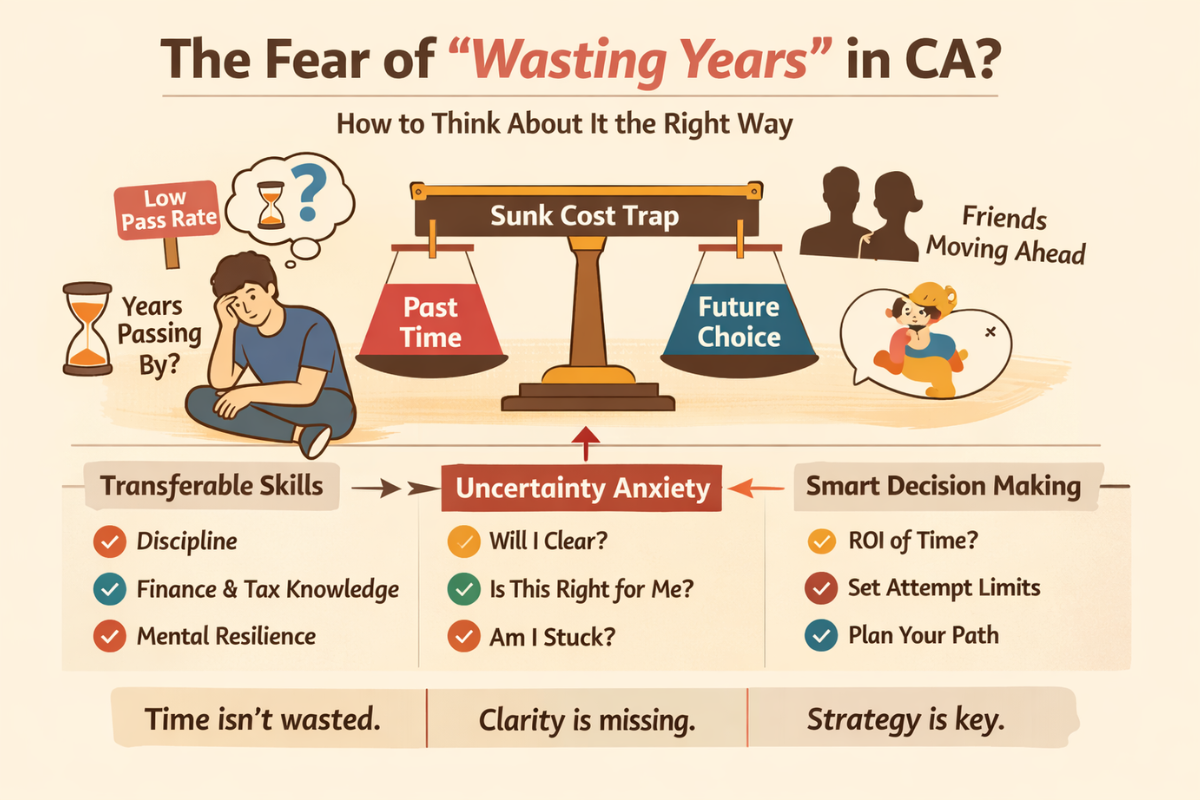
This thought becomes stronger after 2 to 3 years of preparation, especially when attempts do not go as planned or when you see your friends moving ahead in other careers.
If you are thinking like this, you are not alone. Almost every CA student faces this fear at some point.
But the real question is not whether you are wasting years. The real question is whether you are thinking about time in the right way.
This article will help you understand that clearly.
Why does the fear of wasting years in CA feel so real?
The CA journey is different from most other courses.
- It takes a long time to complete, often 4 to 6 years or more depending on attempts. This creates pressure because you feel you are investing a major part of your early career.
- The results are uncertain, and multiple attempts are common. This makes you feel like time is passing without guaranteed progress.
- There is constant comparison with others. Your friends may start earning early, pursue MBA, or get jobs, which increases your anxiety.
Because of all this, your mind starts connecting time with success.
You begin to think that if you do not become a CA, all the years spent were wasted.
This is where the real misunderstanding begins.
Are you actually wasting years in CA?
Let us answer this honestly.
You are not wasting years just because you are in CA.
What matters is what you are doing during those years.
Even if you are not clearing exams immediately, you are still gaining:
- Strong conceptual understanding of accounts, tax, and finance, which is useful in multiple careers beyond CA.
- Discipline and consistency, because preparing for CA requires long hours and focus.
- Mental strength, as handling failure and continuing preparation builds resilience.
These are not small things. These are long term assets.
So, time spent in CA is not automatically wasted. It depends on how you use it.
What is the biggest mistake in thinking about time?
Most students think like this.
“I have already spent 3 years, so I cannot leave now.”
This is called the sunk cost thinking.
You continue something only because you have already invested time, not because it is still the right choice.
This mindset can trap you.
- You stay without clarity.
- You keep giving attempts without improving your approach.
- You delay better opportunities because you are afraid to change direction.
Instead of asking how many years you have spent, you should ask a better question.
“Is continuing this still the right decision for me?”
Your past should not decide your future.
Is the fear really about time or something else?
If you observe carefully, the fear is not actually about time.
It is about uncertainty.
When you say, “I am wasting years”, what you actually mean is:
- “What if I do not clear?”
- “What if this is not the right career for me?”
- “What if I am falling behind others?”
So the real issue is lack of clarity and control.
Once you gain clarity, the fear of wasting years reduces automatically.
When do years actually get wasted in CA?
It is important to be honest here.
Years do get wasted in some cases, but not because of CA itself.
Years get wasted when:
You keep repeating the same mistakes
If your marks are not improving and your study method is the same, then time is passing without progress. You need to change your strategy, not just increase study hours.
You are continuing due to pressure
Many students stay in CA because of family expectations or social pressure. When your decision is not your own, it becomes harder to stay motivated and focused.
You have no clear plan
If you are just giving attempts without a proper plan, timetable, or revision strategy, then you are not using your time effectively.
You ignore your interests and strengths
If you clearly feel that CA does not match your interests, but you continue just because you started it, then you are not being practical.
In all these cases, the issue is not the course. The issue is the approach.
How should you think about time in CA?
You need to shift your thinking from time to value.
Instead of asking, “How many years am I spending?”, ask:
“What am I gaining from these years?”
This is a much more practical way to think.
Focus on return on time
Think of your time like an investment.
You should be getting returns such as:
- Better understanding of subjects
- Improved performance in mock tests
- Stronger discipline and study habits
- Clear career direction
If you are getting these returns, then your time is not wasted.
If you are not getting these returns, then you need to change your strategy.
How can you reduce the fear of wasting years?
You cannot remove this fear completely, but you can manage it with the right approach.
Set a clear attempt limit
Instead of continuing indefinitely, decide in advance.
For example, you can say, “I will give 2 or 3 serious attempts with full preparation.”
This gives you clarity and reduces anxiety because you are not stuck in an endless loop.
Track your progress honestly
Do not just count time. Measure improvement.
Ask yourself:
- Are my marks improving?
- Am I understanding concepts better?
- Am I making fewer mistakes in tests?
If the answer is yes, you are moving forward.
If the answer is no, you need to change your approach immediately.
Keep a backup plan
Having a backup plan does not mean you are giving up.
It means you are being practical.
You can explore options like:
- MBA or other professional courses
- Jobs in accounting or finance
- Skill based certifications
When you have a backup, your fear reduces because you know you are not stuck.
Avoid constant comparison
Comparison increases fear more than anything else.
Your friend getting a job does not mean you are behind. You are on a different path.
Focus on your journey instead of comparing timelines.
Should you continue or pivot?
This is the most important decision.
You should continue if:
- You still have interest in becoming a CA.
- You are improving with each attempt.
- You have a clear strategy and plan.
You should consider pivoting if:
- You have lost interest completely.
- Your performance is not improving despite efforts.
- You are continuing only because of fear or pressure.
There is no shame in changing direction.
The only mistake is staying stuck without thinking.
What is the right mindset to adopt?
You need a balanced mindset.
- Do not think that leaving CA means failure. It just means you chose a different path.
- Do not think that continuing CA guarantees success. You still need effort and strategy.
- Do not measure your worth based on how fast others are moving.
Your goal should be to make informed decisions, not emotional ones.
Conclusion
The fear of wasting years in CA is common, but it is often misunderstood.
You do not waste years by choosing CA. You waste years by staying without clarity, repeating mistakes, and not improving your approach.
Instead of focusing on time, focus on direction and growth.
If you are learning, improving, and moving forward, your time is being used well.
If not, it is a sign to rethink your strategy or your path.
The right decision is not about how many years you have already spent. It is about what makes sense for your future from today onwards.
Once you understand this, the fear of wasting years will not control your decisions anymore.
Calling all CA dreamers!
🔴 Are you tired of searching for the perfect articelship or job?
Well, fear no more! With 15,000+ students and professionals already on board, you don't want to be left behind. Be a part of the biggest community around! Join the most reliable and fastest-growing community out there! ❤️
And guess what? It’s FREE 🤑
✅ Join our WhatsApp Group (Click Here) and Telegram Channel (Click Here) today for instant updates.