When you are a commerce student or a CA aspirant, one big question keeps coming back again and again — are big firms always better for long-term growth?
You hear seniors saying, “Join a Big 4 firm.”
You see LinkedIn posts celebrating corporate brand names.
You may even feel that starting in a large firm automatically guarantees success.
But is that really true?
Let us break this down in a practical and realistic way, so that you can make informed career decisions instead of following hype.

What Do We Really Mean by “Long-Term Growth”?
Before answering whether big firms are always better for long-term growth, it is important to understand what long-term growth actually means for you.
Long-term growth can include:
- Skill development – how much you learn technically and practically over the years.
- Financial growth – how your salary increases with time.
- Position and authority – how fast you move into decision-making roles.
- Professional reputation – how the market sees your experience and profile.
- Work-life balance sustainability – whether you can sustain your career for 20–30 years.
For one person, long-term growth may mean stable salary increments.
For another, it may mean building strong client exposure and starting their own practice later.
So when asking are big firms always better for long-term growth, the answer depends on what you define as growth.
Why Do Big Firms Look Attractive for Long-Term Growth?
Let us first understand why big firms have such a strong reputation.
Large firms — especially well-known audit and consulting companies — offer structured environments. For CA aspirants, this often feels like the safest and smartest path.
Structured Training and Systems
Big firms usually have proper training modules, SOPs, and review mechanisms. You learn how documentation is done, how audits are structured, and how client communication works at a professional level.
This helps you:
- Develop discipline in work.
- Understand compliance and risk frameworks.
- Learn standard industry practices that smaller firms may not follow strictly.
In the long term, this structured exposure can shape your professional foundation strongly.
Brand Value on Your Resume
Let us be honest — brand matters.
If you work in a reputed firm, it adds weight to your CV. Recruiters immediately recognise the firm name. This can open doors when you switch jobs later.
For example, if you aim to move into corporate finance roles, MNCs, or global opportunities, a big firm background can sometimes make the transition easier.
This is one strong reason why many believe big firms are better for long-term growth.
Stability and Financial Security
Large firms usually offer:
- More predictable salary structures.
- Timely increments.
- Formal promotion cycles.
- Better compliance with employment laws.
If your priority is stability and steady income growth, big firms often provide a safer career track.
But does that mean they are always better? Not necessarily.
Are Big Firms Always Better for Long-Term Skill Development?
Now let us look at the other side.
In large firms, work is often highly specialised. You may work only in:
- Statutory audit of listed companies.
- GST compliance for large clients.
- Internal audit of one sector.
- Transfer pricing documentation.
This specialisation has advantages. You become very strong in a specific domain.
However, there is also a limitation.
You may not get exposure to:
- Client acquisition.
- End-to-end business handling.
- Direct strategic discussions.
- Broad tax planning or litigation exposure.
If your long-term goal is to start your own CA practice, you may feel that you have deep but narrow expertise.
So when asking are big firms always better for long-term growth, you must ask yourself — do you want depth or breadth?
Can Mid-Sized and Small Firms Offer Better Practical Exposure?
This is where many students underestimate opportunities.
In small or mid-sized firms, you may not get a global brand name. But you often get something equally valuable — hands-on exposure.
Wider Scope of Work
In a smaller firm, you may handle:
- Income tax returns.
- GST filings.
- Audit work.
- Client meetings.
- Drafting notices and replies.
- ROC compliance.
- Basic advisory.
You may interact directly with clients instead of only seniors.
This builds confidence and real-world understanding. You start seeing how businesses operate, not just how reports are prepared.
For someone who wants to open their own firm in future, this broad exposure can be extremely powerful for long-term growth.
Faster Responsibility
In big firms, hierarchy is strict. It may take time before you get independent responsibility.
In smaller setups, because the team is limited, you may be trusted earlier with important tasks. This accelerates maturity and decision-making skills.
That kind of learning cannot always be measured in salary terms, but it contributes significantly to long-term professional growth.
Is Job Security Higher in Big Firms?
Many students assume that big firms automatically guarantee job security.
In reality:
- Large firms can also downsize.
- Economic slowdown affects all companies.
- Performance expectations are very high.
While large firms are more stable overall, job security ultimately depends on your competence and adaptability.
Long-term growth does not come from company size alone. It comes from how relevant your skills remain in the market.
If you continuously upgrade yourself — in taxation, audit analytics, finance tools, and regulations — you will grow irrespective of firm size.
What About Work-Life Balance and Burnout?
This is an important but often ignored factor.
Big firms are known for:
- Long working hours.
- Tight deadlines.
- Intense client pressure.
- Busy season stress.
While this teaches resilience, it can also cause burnout if not managed properly.
If you want sustainable long-term growth, your physical and mental health matter.
Sometimes, smaller firms offer relatively manageable workloads and better personal balance. That balance can help you prepare for exams, upskill, or plan entrepreneurial goals.
So again, big firms are not always better for long-term growth in every dimension.
Should You Start in a Big Firm and Then Shift?
Many mentors suggest a balanced approach.
You can:
- Start your articleship or early career in a big firm to gain structured exposure and brand value.
- Later move to a mid-sized firm or corporate role based on your goals.
- Eventually specialise or start your own practice.
Career growth is not linear. It is strategic.
Instead of asking whether big firms are always better for long-term growth, a better question is:
“How can I use each stage of my career wisely?”
What Type of Growth Do You Want?
Let us simplify this practically.
If you want
- Strong brand name on CV
- Corporate or MNC career
- Structured promotions
- Global exposure
Then big firms may support your long-term growth goals.
If you want
- To start your own CA practice
- Direct client handling experience
- Exposure to multiple areas
- Faster independent responsibility
Then mid-sized or smaller firms may actually offer better long-term growth for your specific path.
Growth is personal. There is no one-size-fits-all answer.
How Should a CA Aspirant Decide?
Instead of following peer pressure, ask yourself:
- What kind of CA do I want to become?
- Do I enjoy structured corporate systems or flexible environments?
- Am I aiming for entrepreneurship in future?
- Do I value brand more or practical exposure more?
- Can I handle high-pressure work culture comfortably?
Write down your answers honestly.
Long-term growth is built on alignment. If your work environment matches your personality and goals, you will grow faster.
Are Big Firms Always Better for Long-Term Growth? The Final Verdict
So, are big firms always better for long-term growth?
The simple answer is — No, not always.
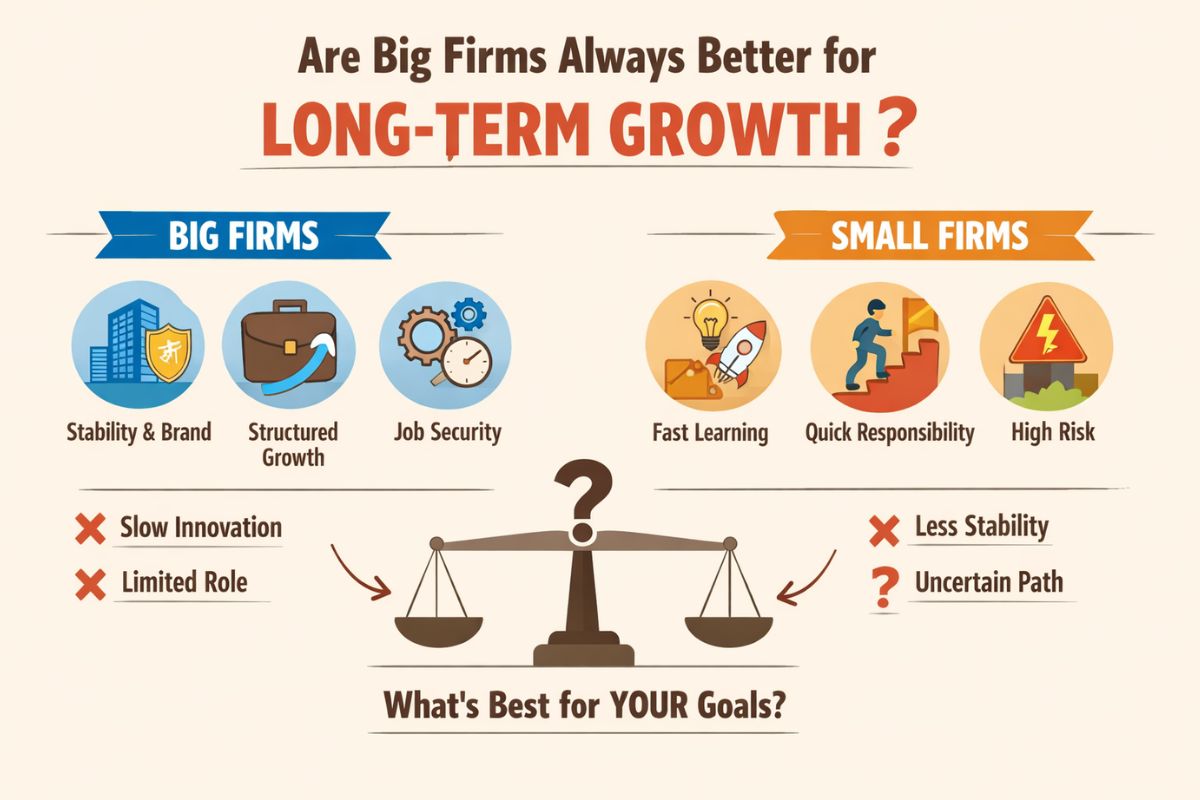
Big firms offer:
- Brand recognition
- Structured learning
- Stable increments
- Corporate exposure
But smaller and mid-sized firms offer:
- Broader practical exposure
- Direct client interaction
- Faster responsibility
- Entrepreneurial learning
Long-term growth depends more on:
- Your learning attitude
- Your consistency
- Your skill upgradation
- Your clarity of goals
A mediocre professional in a big firm will not grow automatically.
A focused and proactive professional in a smaller firm can build a very strong career.
Conclusion: Focus on Growth, Not Just Firm Size
As a commerce student or CA aspirant, do not get carried away by brand names alone.
Big firms are not automatically better for long-term growth. They are one pathway — not the only pathway.
Choose environments that:
- Challenge you.
- Teach you.
- Align with your goals.
- Help you stay consistent for the next 20–30 years.
At the end of the day, your growth depends more on what you learn and how you apply it — not just where you work.
Think long-term. Think strategically. And most importantly, think independently.
Calling all CA dreamers!
🔴 Are you tired of searching for the perfect articelship or job?
Well, fear no more! With 15,000+ students and professionals already on board, you don't want to be left behind. Be a part of the biggest community around! Join the most reliable and fastest-growing community out there! ❤️
And guess what? It’s FREE 🤑
✅ Join our WhatsApp Group (Click Here) and Telegram Channel (Click Here) today for instant updates.