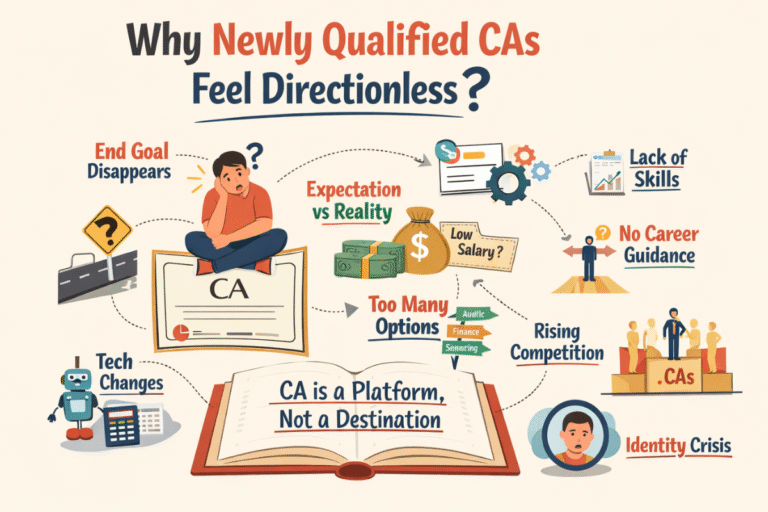
Many CA aspirants and newly qualified professionals believe that career decisions can always be corrected later. The thought process is simple. “Let me just start somewhere. I will figure it out with time.”
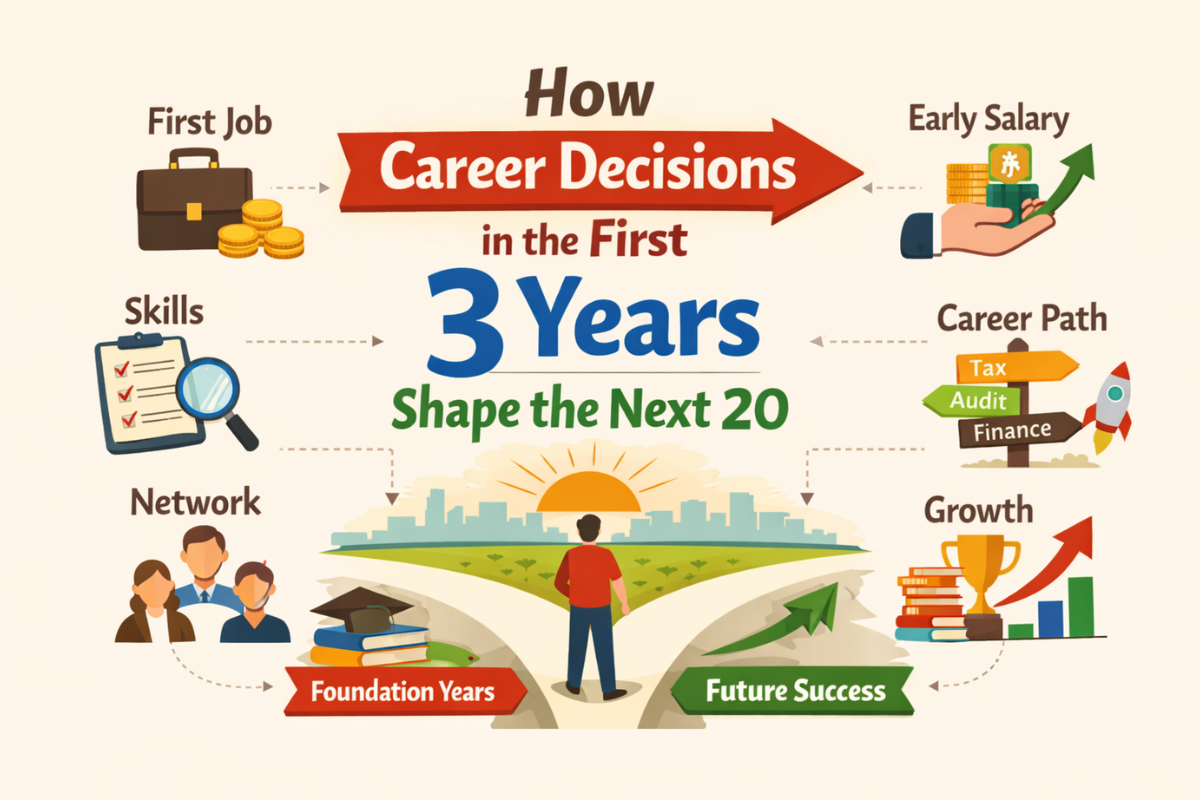
But in reality, career decisions in the first 3 years shape the next 20 years more than you think.
These early years are not just about getting a job. They are about building direction, identity, and momentum. What you choose, what you learn, and where you work in the beginning often decide how fast and how far you grow later.
Let us understand this in a practical and simple way.
Why Do the First 3 Years of Your Career Matter So Much?
The first 3 years of your career act like a foundation. Just like a building depends on how strong its base is, your career depends on how these early years are used.
In these years, you are:
- Learning how real work happens outside books and exams
- Building habits around discipline, deadlines, and responsibility
- Understanding what kind of work suits you and what does not
If you use this phase properly, you create a strong base. If you ignore it, you may spend years correcting mistakes later.
How Do Career Decisions in the First 3 Years Shape the Next 20?
Your First Job Sets the Direction of Your Career
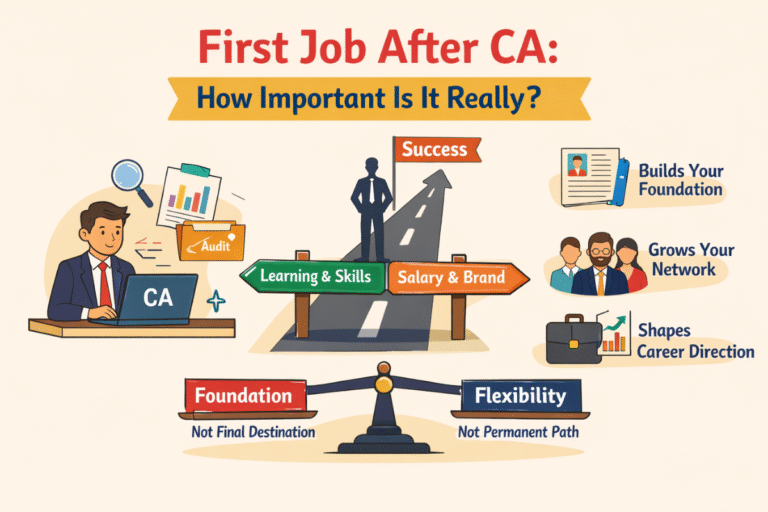
Your first job is not just about earning. It is about deciding your direction.
For example:
- If you start in audit, you will gradually build expertise in auditing and assurance
- If you start in taxation, your knowledge and exposure will revolve around tax laws
- If you go into industry roles, your skills will be more business and operations-focused
Over time, your experience builds in that direction. After a few years, switching becomes difficult because employers prefer candidates with consistent experience.
That is why choosing your first role carefully is important.
Early Salary Decisions Affect Long-Term Growth
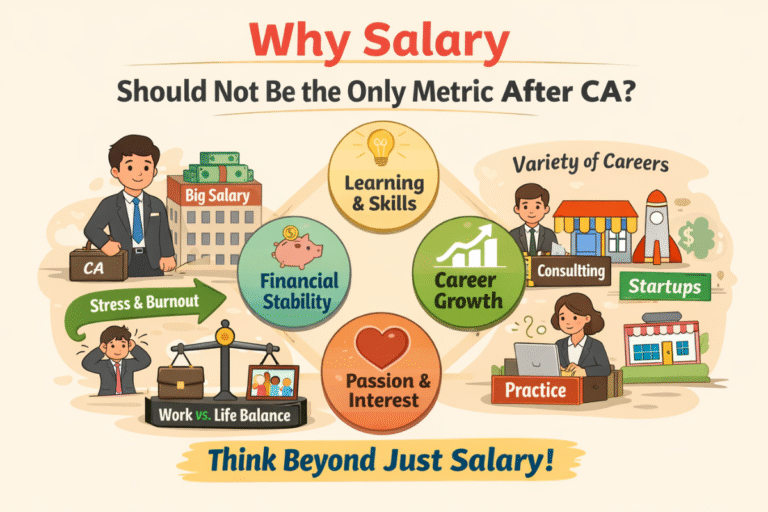
Many students focus only on the starting salary. But what matters more is the growth potential of that role.
If you choose:
- In a slightly lower-paying role with high learning, your income can grow faster in the long run
- In a higher-paying but low-learning role, your growth may slow after a few years
Your first salary often becomes a benchmark for future negotiations. If your starting point is low and growth is limited, it takes time to catch up.
So instead of asking “How much am I earning now?”, ask “How much can I grow here?”
Skills You Build Early Become Your Identity
In the first 3 years, you are not just working. You are becoming known for something.
If you repeatedly work on:
- Tax returns and compliance, you become a taxation professional
- Internal audits and reports, you become an audit specialist
- Financial analysis and MIS, you become a finance professional
Later, when someone looks at your profile, they will see your experience and place you in a category.
This is why your early skill-building decisions matter a lot. They define how the market sees you.
Your Work Environment Shapes Your Learning Speed
Not all workplaces are equal. The environment you choose in the beginning directly impacts how fast you learn.
A good environment will:
- Give you practical exposure instead of only routine work
- Allow you to interact with seniors and learn from them
- Involve you in real problem-solving situations
On the other hand, a poor environment may:
- Limit you to repetitive tasks
- Offer little guidance or mentorship
- Slow down your overall growth
So while choosing a job, you must look beyond the brand name. Ask yourself whether you will actually learn there.
Early Career Choices Influence Your Network
In the first few years, you build your professional network. This includes:
- Seniors who guide you
- Colleagues who grow with you
- Clients and professionals you interact with
This network becomes very valuable over time. Many opportunities come through people, not job portals.
If you start in a place where you meet skilled professionals and serious learners, your network becomes stronger. If not, your exposure remains limited.
Early Mistakes Can Slow You Down
It is normal to make mistakes. But some career decisions in the first 3 years can have a long-term impact if not corrected.
For example:
- Staying too long in a role with no learning can delay your growth significantly
- Choosing convenience over learning can reduce your future opportunities
- Ignoring skill-building can make you less competitive later
The key is not to avoid mistakes completely. The key is to identify them early and take corrective action quickly.
What Should You Focus on in the First 3 Years?
Now that you understand how career decisions in the first 3 years shape the next 20, let us focus on what you should actually do.
Should You Prioritise Learning Over Salary?
Yes, especially in the beginning.
In the first few years, your main goal should be to learn as much as possible. This does not mean ignoring salary completely, but learning should come first.
For example:
- If a job offers strong exposure in audit, taxation, or finance, it can benefit you for years
- If a job pays well but does not teach you much, your growth may be slow later
Think of it as an investment phase.
How Do You Choose the Right Work Environment?
Before accepting any job, ask yourself a few practical questions:
- Will I get hands-on experience here?
- Will seniors guide me or just assign work?
- Will I learn something new every few months?
If the answer to these questions is yes, it is likely a good environment.
You can also talk to existing employees or seniors to understand the real work culture.
Why Is Skill-Building Important in the First 3 Years?
Your skills are your biggest asset.
In the CA profession, some key skills you should focus on include:
- Drafting and documentation, which help you communicate professionally and handle clients better
- Analytical skills, which allow you to understand financial data and make better decisions
- Practical knowledge of laws and compliance, which is essential for real-world work
The more skills you build early, the more confident and valuable you become.
Should You Decide Your Career Path Early?
You do not need to have everything figured out immediately. But having some direction helps.
For example, you can start by deciding:
- Whether you are more interested in practice or job
- Whether you prefer taxation, audit, finance, or consulting
- Whether you want to work in a firm or in industry
This clarity helps you make better choices and avoid random decisions.
How Important Is Networking in the Early Stage?
Networking is extremely important, even in the first 3 years.
You can build your network by:
- Staying in touch with your articleship seniors and colleagues
- Attending seminars, webinars, and professional events
- Connecting with professionals on platforms like LinkedIn
These connections may not give immediate benefits, but they can open doors in the future.
Can You Change Your Path After the First 3 Years?
Yes, you can. Your career is not completely fixed.
However, changing your path later requires:
- Additional effort to learn new skills
- Time to gain relevant experience
- Sometimes, a temporary step back in position or salary
That is why it is better to be thoughtful in the beginning rather than correcting everything later.
Conclusion
Career decisions in the first 3 years shape the next 20 in ways that are not always visible immediately.
These years decide:
- The direction of your career
- The skills you build
- The network you create
- The speed at which you grow
If you focus on learning, choose the right environment, and build strong skills, you set yourself up for long-term success.
At the same time, do not panic if things are not perfect. What matters is that you stay aware, keep improving, and make better decisions as you move forward.
In simple terms, your early career is not about being perfect. It is about being intentional.
Calling all CA dreamers!
🔴 Are you tired of searching for the perfect articelship or job?
Well, fear no more! With 10K+ students and professionals already on board, you don't want to be left behind. Be a part of the biggest community around! Join the most reliable and fastest-growing community out there! ❤️
And guess what? It’s FREE 🤑
✅ Join our WhatsApp Group (Click Here) and Telegram Channel (Click Here) today for instant updates.