Many CA aspirants and young professionals enter compliance roles because they are stable, respected, and relatively easier to enter compared to core finance or consulting roles. However, after a few years, many realise something important. Growth becomes slow, work becomes repetitive, and career options start shrinking.
If you are planning a career in compliance or already working in one, this is something you must understand early. This article will help you understand how to avoid getting stuck in compliance-only roles and build a career with long-term growth and flexibility.
What Are Compliance-Only Roles and Why Do People Get Stuck?
Compliance roles mainly involve ensuring that a company follows laws, regulations, and internal policies. This includes areas like audit compliance, regulatory filings, KYC checks, and internal controls.
At the beginning, this work feels structured and safe. You know what to do, deadlines are clear, and there is less uncertainty. But over time, problems start appearing.
Here is why people get stuck:
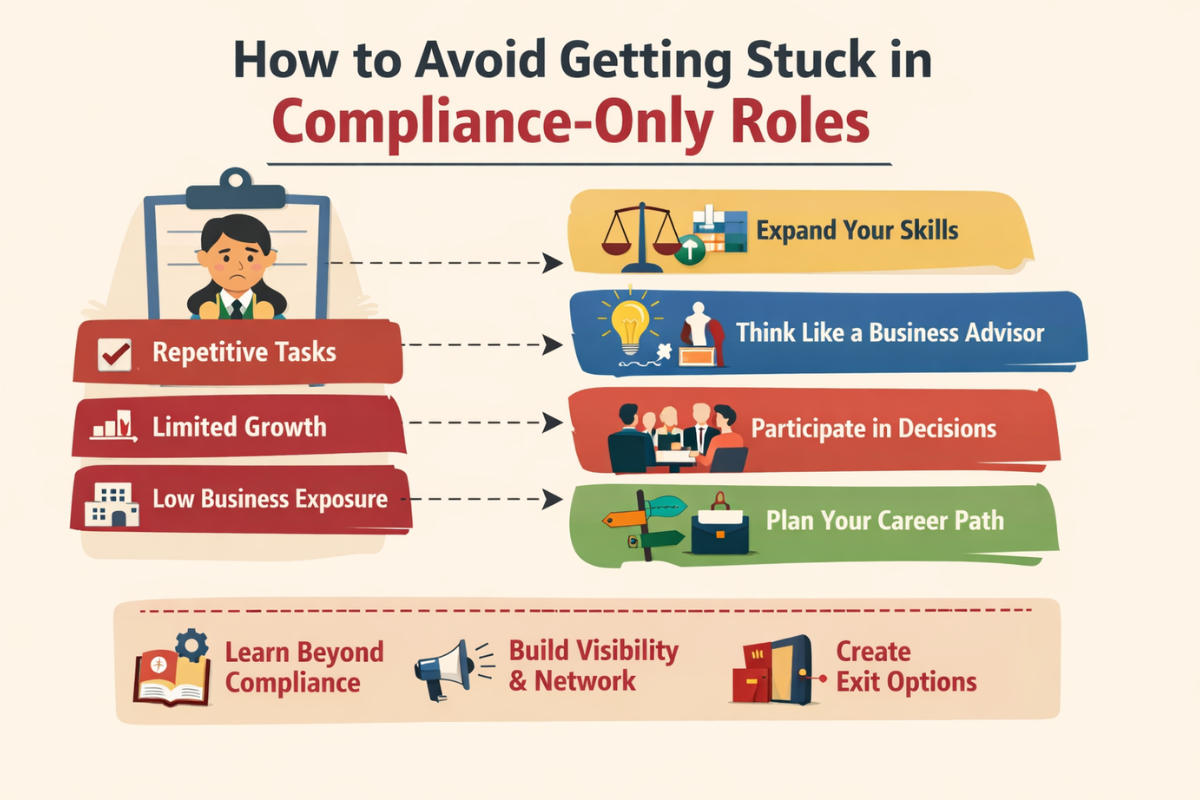
- Work becomes repetitive and process-driven
Most compliance tasks follow fixed checklists. You verify documents, complete filings, and ensure rules are followed. Over time, this reduces learning and limits your ability to think strategically. - Limited exposure to business decisions
Compliance teams are often not involved in revenue or strategy discussions. This means you may not understand how businesses grow, which affects your overall career development. - Skills become too narrow
If you only work in one area like GST compliance or internal audit, your expertise becomes very specific. This makes it difficult to switch roles later. - Lower visibility within the organisation
Compliance work is often behind the scenes. Senior management may not notice your contribution as much as they notice people in finance or strategy roles.
Understanding these issues early helps you take corrective steps before it becomes difficult to switch.
Why Should You Avoid Getting Stuck in Compliance-Only Roles?
Compliance is an important function, but staying limited to it can restrict your growth.
Here is why you should actively avoid getting stuck:
- Limited salary growth in many cases
Compared to roles in investment banking, consulting, or strategic finance, compliance roles often have slower salary progression unless you reach very senior positions. - Fewer exit opportunities
If your experience is only in compliance, moving to roles like corporate finance, advisory, or consulting becomes difficult. - Risk of automation
Many compliance tasks are becoming automated through software and AI tools. If your work is only process-based, your role may lose value over time. - Lack of strategic exposure
Without involvement in decision-making, you may miss out on developing leadership skills.
This does not mean you should avoid compliance completely. Instead, you should approach it in a smarter way.
How to Avoid Getting Stuck in Compliance-Only Roles?
Do You Understand the Business Behind Compliance?
One of the biggest mistakes professionals make is focusing only on rules without understanding the business.
Instead of just completing tasks, start asking:
- Why does this regulation exist?
- How does this impact the company’s operations?
- What risks is the company trying to avoid?
When you understand the business side, you start adding more value.
For example, instead of just pointing out a compliance issue, you can suggest a practical solution that allows the business to move forward safely. This makes you more valuable and visible.
Are You Building Skills Beyond Compliance?
If your only skill is compliance, your growth will be limited. You must develop additional skills that complement your role.
You can focus on areas like:
- Financial analysis and business understanding
Learning how to read financial statements, analyse performance, and understand business models helps you move into finance roles. - Risk management and internal controls
These skills are closely related to compliance but have higher strategic importance. They can open doors to senior roles. - Technology and data skills
Understanding tools like Excel, Power BI, or even basic data analysis can help you handle larger responsibilities and improve efficiency. - Regulatory advisory and interpretation
Instead of just following rules, learn to interpret laws and advise businesses. This shifts you from execution to thinking roles.
When you combine compliance with another strong skill, your career options expand significantly.
Are You Moving Towards Decision-Making Roles?
Growth in any career comes from being involved in decisions.
You should gradually move from:
- Doing tasks
- To explaining issues
- To suggesting solutions
- To influencing decisions
You can start small:
- Volunteer to present compliance findings to seniors
- Share suggestions during meetings
- Take ownership of small projects
Over time, this builds confidence and visibility.
When management sees you as someone who can think and not just execute, your career path changes.
Are You Avoiding Over-Specialisation Too Early?
Specialisation is good, but doing it too early can limit your career.
For example, if you spend your first three to four years only in GST compliance, it becomes difficult to move into other areas like corporate finance or consulting.
In the initial years, focus on:
- Getting exposure to multiple areas
- Understanding different types of compliance
- Learning how different departments function
Once you have a broad base, you can choose a specialisation that aligns with your long-term goals.
Are You Choosing the Right Organisation?
Your growth depends a lot on where you work.
Some organisations treat compliance as a routine function, while others give it strategic importance.
When choosing a company, look for:
- Opportunities to interact with different teams
- Exposure to senior management
- Learning opportunities beyond your role
- A culture that values ideas and suggestions
A good organisation can accelerate your growth, while the wrong one can slow it down.
Are You Building a Visible Professional Profile?
Many professionals do good work but remain unnoticed because they do not build visibility.
You can improve this by:
- Writing about compliance updates or practical insights
- Sharing your learnings on LinkedIn
- Participating in webinars or discussions
- Connecting with professionals in related fields
When people know your work, opportunities start coming to you instead of you chasing them.
Do You Have Exit Options in Mind?
One of the smartest things you can do is plan your career path early.
Ask yourself:
- Where do I want to be after five years?
- What roles can I move into from compliance?
Some common exit options include:
- Risk management roles
- Internal audit leadership
- Financial advisory
- Consulting
- In-house finance or strategy roles
When you keep these options in mind, you start building the right skills and experience from the beginning.
Are You Creating Value or Just Following Rules?
This is the most important shift.
There are two types of professionals in compliance:
- Those who say no and stop things
- Those who find ways to make things work safely
If you want to grow, become the second type.
For example:
- Instead of saying a transaction is not allowed, explain why and suggest an alternative structure
- Instead of just identifying risks, recommend practical solutions
This mindset makes you a business partner rather than just a compliance officer.
Simple Signs That You Are Getting Stuck
It is important to regularly evaluate your situation.
You might be getting stuck if:
- Your work has not changed in the last one or two years
- You are not learning anything new
- You are not involved in discussions or decision-making
- You feel your skills are limited to one area
If you notice these signs, take action immediately.
Conclusion
Compliance is a strong and respectable career path, but only if approached correctly. Getting stuck in compliance-only roles usually happens when work becomes repetitive, skills remain limited, and there is no exposure to business decisions.
You can avoid this by understanding the business behind compliance, building additional skills, seeking decision-making opportunities, and maintaining visibility. Most importantly, focus on creating value instead of just following rules.
If you plan your career early and take the right steps, compliance can become a powerful foundation for a long and successful professional journey.
Calling all CA dreamers!
🔴 Are you tired of searching for the perfect articelship or job?
Well, fear no more! With 10K+ students and professionals already on board, you don't want to be left behind. Be a part of the biggest community around! Join the most reliable and fastest-growing community out there! ❤️
And guess what? It’s FREE 🤑
✅ Join our WhatsApp Group (Click Here) and Telegram Channel (Click Here) today for instant updates.