If you are pursuing Chartered Accountancy, there is a silent fear many students have but rarely talk about.
You may be attending classes, clearing levels, preparing for exams — yet somewhere in your mind, you worry:
“I am not a CA yet. How will I impress anyone?”
This fear becomes stronger when:
- you apply for articleship,
- you send your resume to a CA firm,
- or you look at profiles of other students who already seem ahead.
This is exactly where most CA students go wrong.
Because the reality is very simple:
You do not need to become a CA first to start looking professional.
Your resume is not a certificate of qualification.
It is a reflection of your preparation, seriousness, and professional attitude.
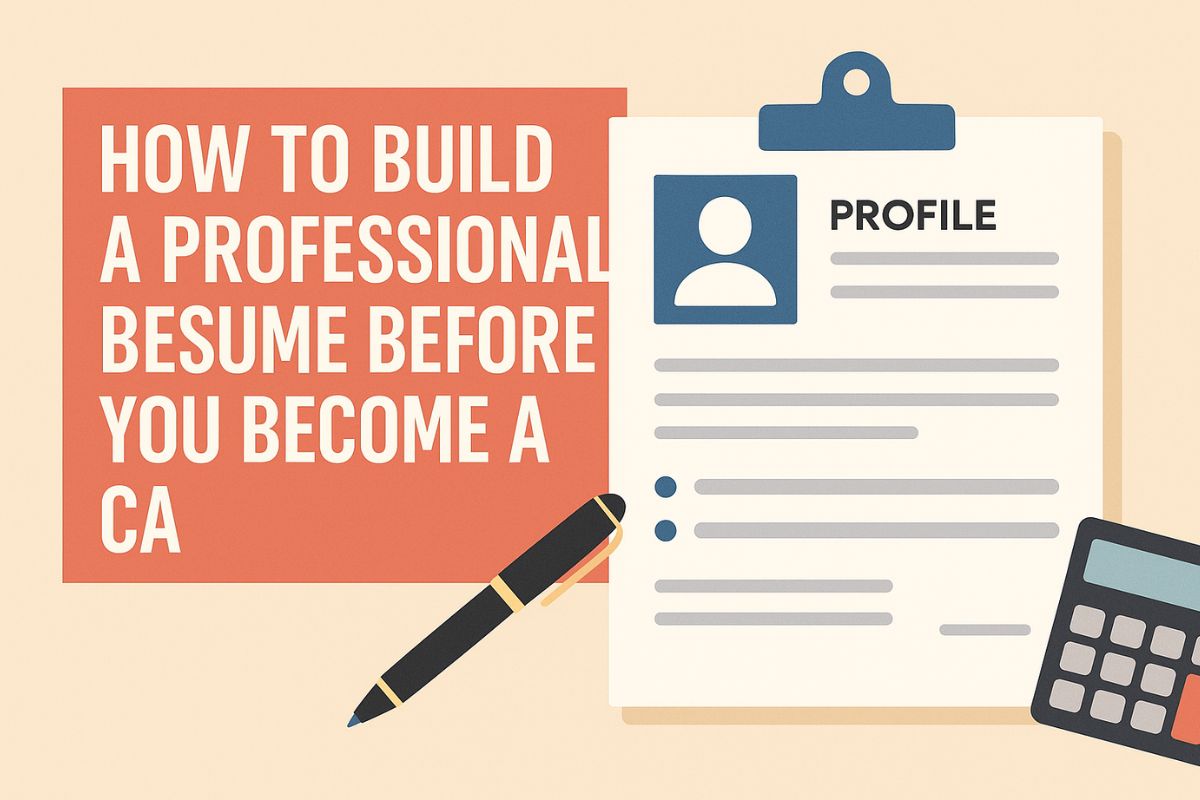
This article will help you understand — in detail — how to build a resume that actually works for you before you become a CA, not after.
Why Resume Building Cannot Wait Till CA Final
Many students think resume building is something to do after qualification.
That thinking costs opportunities.
CA firms and organisations do not expect perfection from a student. What they expect is:
- clarity of thought,
- willingness to learn,
- basic practical understanding,
- and discipline.
Your resume is often the first and only thing a firm sees before deciding whether to call you.
If your resume looks:
- empty,
- confused,
- generic,
- or copied,
the firm assumes your thinking is the same.
A good resume, on the other hand, tells them:
“This student understands where they stand and knows where they want to go.”
That is powerful — even before qualification.
Understand This First: Your Resume Is Not a List of Degrees
Before we go section by section, you must change one mindset.
Your resume is not:
- a marksheet,
- a biography,
- or a place to show off language.
Your resume is a problem-solving document.
It answers one simple question:
“Why should we consider this student?”
Once you understand this, writing content becomes meaningful instead of mechanical.
The Overall Structure of a Strong CA-Student Resume
A professional resume before you become a CA should have:
- Clear personal details
- Thoughtful career objective
- Transparent education and CA status
- Relevant practical exposure
- Useful skills section
- Additional learning and certifications
- Optional achievements
Each of these needs explanation, not decoration.
Personal Details: Simple, Clean, Professional
This seems basic, but many resumes fail here.
Your personal details should instantly show maturity.
You should mention:
- your full name,
- city and state (not full address),
- phone number,
- professional email ID.
Avoid unnecessary personal information like:
- date of birth,
- parents’ names,
- religion or caste,
- photograph (unless specifically asked).
CA firms value privacy and professionalism.
Your resume should reflect that.
Career Objective: This Is Where Most Students Go Wrong
The career objective is often the most meaningless part of a resume — because students treat it like a formality.
You should not.
This section tells the firm:
- who you are,
- where you are in the CA journey,
- and what exposure you are looking for.
Instead of writing vague lines, you should connect your present stage with your future goal.
For example, if you are a CA Inter student, your objective should show:
- interest in practical exposure,
- eagerness to learn,
- and relevance to the role you are applying for.
This makes your resume feel focused, not random.
Education and CA Status: Honesty Builds Trust
This section must clearly show your academic journey.
You should mention:
- your graduation or higher secondary qualification,
- the institution name,
- year of passing,
- and your CA level with status.
Never try to hide failures or attempts.
Why?
Because CA firms understand the course better than anyone else.
Trying to manipulate details only damages credibility.
Instead, if you have strengths like:
- strong marks in accounting or tax,
- exemptions,
- consistent academic record,
mention them calmly.
Clarity here gives confidence to the recruiter.
Practical Exposure: This Is the Heart of Your Resume
This section matters more than anything else.
Many CA students believe:
“I have not done articleship yet, so I have no experience.”
That belief is incorrect.
Practical exposure does not only mean formal articleship.
It includes:
- internships,
- accounting assistance,
- tax return preparation support,
- Excel-based work,
- audit documentation help,
- CA office assistance,
- even serious academic projects with practical application.
What matters is what you learned, not how famous the organisation was.
When you write this section, focus on:
- what tasks you handled,
- what knowledge you applied,
- what kind of environments you worked in.
Avoid writing only designations.
Explain your role in simple words.
This helps firms understand how job-ready you already are.
Skills Section: Show What You Can Actually Do
A skills section should never be a random list.
It should answer:
“What can this student contribute immediately?”
As a CA aspirant, your skills generally fall into two categories.
Technical Skills
These show your professional readiness.
Mention things like:
- accounting fundamentals,
- income tax basics,
- GST concepts,
- audit procedures (even theoretical),
- Excel or accounting software.
Only write skills you genuinely understand.
Honest skills > long skill lists.
Soft Skills
These show your working style.
CA firms value people who:
- meet deadlines,
- communicate clearly,
- pay attention to detail,
- handle pressure calmly.
Soft skills matter because CA work involves responsibility, not just numbers.
Certifications and Learning: This Shows Seriousness
Doing only what the syllabus demands is not enough.
When you include certifications or training, you show:
- initiative,
- curiosity,
- professional seriousness.
It could be:
- accounting software training,
- Excel courses,
- GST workshops,
- finance or auditing courses,
- law-related short programmes.
This section silently tells the firm:
“This student is investing in their growth.”
That impression matters.
Achievements and Activities: Keep Them Relevant
This section is optional but useful.
It helps humanise your profile.
You can include:
- academic awards,
- scholarships,
- leadership roles,
- participation in committees,
- responsibilities that required discipline.
Avoid adding fillers for the sake of space.
Quality matters more than quantity.
Resume Presentation: Looks Matter, But Simplicity Wins
A resume should look calm, not busy.
Use:
- one font,
- proper spacing,
- consistent formatting,
- bullet points where helpful.
Avoid:
- excessive bolding,
- multiple colours,
- decorative designs.
In CA practice, clarity equals trust.
The Most Important Truth: Your Resume Reflects Your Mindset
A weak resume often reflects:
- confusion,
- lack of preparation,
- fear of exposure.
A strong resume reflects:
- direction,
- honesty,
- professional thinking.
Remember:
You are not competing as a “student”.
You are preparing as a professional in training.
Final Thoughts
Building a professional resume before becoming a CA is not about pretending to be something you are not.
It is about presenting who you already are, with clarity and confidence.
When you do that right, opportunities start noticing you — quietly but consistently.
Calling all CA dreamers!
🔴 Are you tired of searching for the perfect articelship or job?
Well, fear no more! With 10K+ students and professionals already on board, you don't want to be left behind. Be a part of the biggest community around! Join the most reliable and fastest-growing community out there! ❤️
And guess what? It’s FREE 🤑
✅ Join our WhatsApp Group (Click Here) and Telegram Channel (Click Here) today for instant updates.