If you are a CA article assistant or a commerce graduate working in an office, you might have faced this situation: you join with high expectations, but instead of learning taxation, audit, GST, or financial reporting in depth, you are given routine tasks. No one explains concepts. No one mentors you properly.
This is more common than people admit.
The truth is simple — your office may give you exposure, but your growth depends on how you learn. If your office does not teach, you must learn strategically on your own.
In this article, let us understand how to learn when your office does not teach, especially as a CA aspirant or commerce professional.
Why Does Your Office Not Teach You?
Before finding solutions, it is important to understand the reality.
Most CA firms and finance offices are busy. Seniors are handling deadlines, client meetings, scrutiny notices, audits, and compliance pressure. Teaching takes time, and not everyone has the patience or skill to explain things properly.
This does not mean your career is stuck. It simply means you need to take control.
Instead of thinking, “They are not teaching me,” shift your mindset to, “How can I learn from whatever I am getting?”
That shift changes everything.
How to Learn When Your Office Does Not Teach?
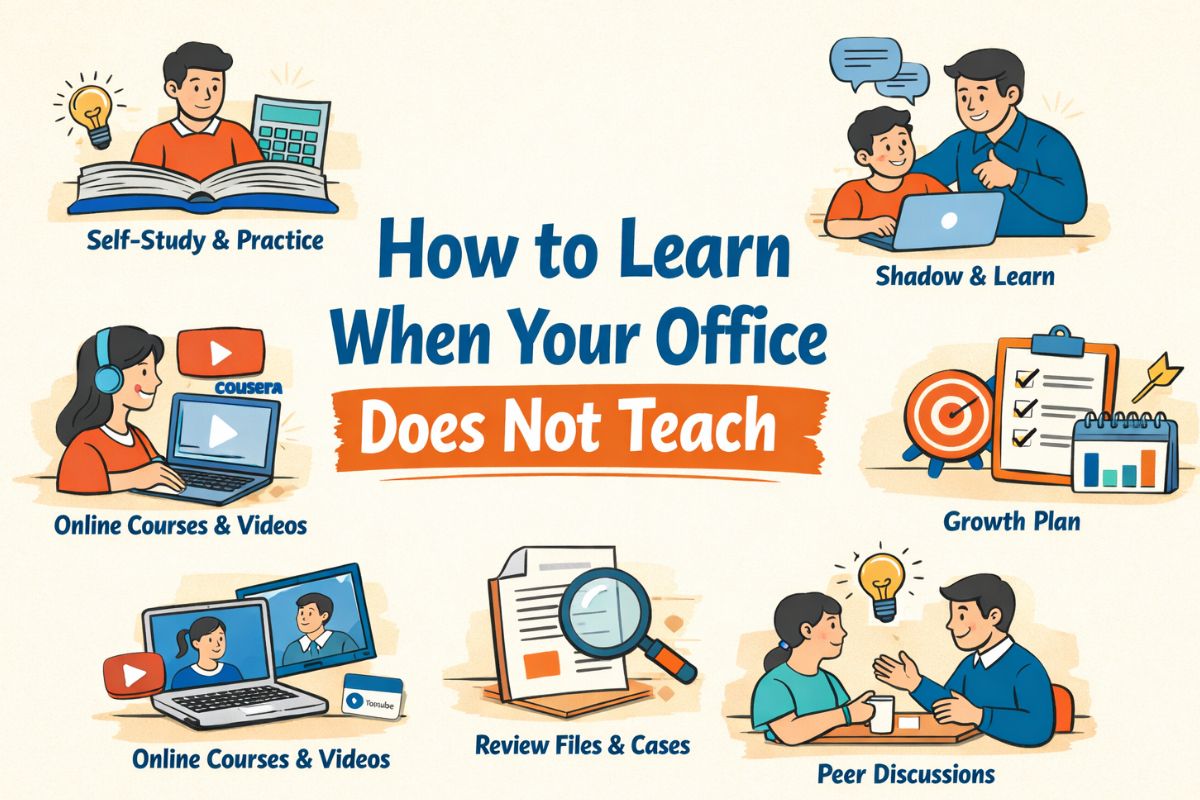
Now let us come to the practical part. If your office does not teach, you must build your own learning system.
Can You Convert Routine Work into Learning?
Even the smallest tasks can become learning opportunities if you approach them correctly.
For example:
- If you are entering purchase invoices in Tally, do not just post entries mechanically. Take 10 minutes to understand why input tax credit is claimed in that way and under which section of GST it is allowed.
- If you are preparing a simple balance sheet, check Schedule III of the Companies Act and see how classification is done. This builds conceptual clarity.
- If you are filing an income tax return, read the relevant provisions of the Income Tax Act once. Even if you do not understand everything, familiarity builds confidence.
The key point is this: never treat any task as “just work.” Treat it as practical training.
Are You Studying Along with Practical Work?
Many CA aspirants make one mistake — they separate office work and studies.
But the best learning happens when theory and practice go together.
If your office does not teach:
- Whenever you work on GST returns, revise GST concepts from your books on the same day.
- If you assist in statutory audit, read SA 200 or SA 315 in your study material that week.
- If you prepare TDS working, revise TDS provisions in detail.
When you connect practical work with theory, concepts become permanent in your mind.
Even if your senior does not explain, your books will.
Are You Asking the Right Questions?
Many students hesitate to ask questions. Either they feel shy, or they are afraid seniors will get irritated.
But here is the truth: asking smart questions is part of learning.
Instead of asking vague questions like “Sir, what is this?”, try asking specific questions such as:
- “Under which section is this expense disallowed?”
- “Why are we not claiming this input tax credit?”
- “Is this treatment as per AS or Ind AS?”
When you ask thoughtful questions, seniors are more likely to respond positively. Even if they give short answers, those small explanations add up over time.
Remember, no one will spoon-feed you. But if you show seriousness, people notice.
Can You Create Your Own Learning Plan?
If your office does not teach, you need a structured personal growth plan.
Sit down and write:
- Which areas do you want to master? (GST, Direct Tax, Audit, Companies Act, Excel, Financial Analysis)
- Which areas is your office not giving enough exposure in?
- What resources can you use to fill the gap?
For example:
- If your office does not give you GST litigation exposure, read recent case laws weekly.
- If you are not getting audit fieldwork, revise audit standards and solve practical case studies.
- If Excel skills are weak, learn advanced Excel formulas through online tutorials.
When you plan your learning, your growth becomes intentional, not accidental.
How Can You Use Online Resources Smartly?
Today, learning is no longer limited to office training.
If your office does not teach, you can use:
- YouTube lectures for concept clarity in taxation and audit.
- Online CA platforms that explain amendments and case laws.
- ICAI website resources for updated notifications and guidance notes.
- Finance blogs and professional articles to understand real-world interpretation of law.
But one caution — do not consume content randomly.
Choose one topic, study it deeply, and apply it in practical work. Consistency matters more than quantity.
Can You Learn from Files and Past Records?
Your office may not teach verbally, but files teach silently.
Ask for access to:
- Previous audit files
- Assessment orders
- Appeal drafts
- GST notices and replies
- Financial statements of big clients
Reading these documents carefully improves your drafting, understanding, and professional language.
Even if no one explains them, analysing real documents builds maturity.
This is one of the most underrated ways to learn when your office does not teach.
Are You Observing How Seniors Handle Clients?
Learning is not only technical. It is also about professional behaviour.
Observe how seniors:
- Talk to clients during meetings.
- Explain complex tax provisions in simple language.
- Negotiate fees.
- Handle difficult questions calmly.
- Manage deadlines under pressure.
These soft skills are not written in books, but they shape your career.
Even if no one sits down to teach you, observation itself is training.
Are You Improving Your Technical Skills Independently?
As a commerce student or CA aspirant, technical skills are very important.
If your office does not teach advanced tools, learn them yourself:
- Improve Excel skills (VLOOKUP, Pivot Tables, basic macros).
- Understand accounting software properly instead of just entering data.
- Learn how to draft professional emails and reports.
- Practise reading financial statements critically.
These skills make you more valuable in any firm.
And when you switch jobs or qualify as a CA, these self-developed skills will differentiate you from others.
Are You Building a Learning Network?
Sometimes your office environment is limited. But your learning does not have to be.
Connect with:
- Other CA articles in different firms.
- Seniors who have cleared CA recently.
- Faculty members or mentors.
- Online CA communities.
Discuss doubts. Share experiences. Ask how they are learning.
When you talk to others, you realise that many face similar issues. And often, they share practical solutions that work.
Learning does not always come from your immediate office.
What Mindset Should You Maintain?
If your office does not teach, frustration is natural.
But instead of blaming the system, build resilience.
Understand these points clearly:
- No office will teach everything.
- Even in the best firms, self-learning is essential.
- Your qualification is your responsibility.
- Long-term growth depends on initiative.
If you develop the habit of learning independently during articleship or early job years, it becomes your biggest strength later in practice or industry.
Is Changing Office the Only Solution?
Sometimes, yes.
If your office is completely non-supportive, does not give exposure, and restricts learning even after genuine efforts, then evaluating a change may be practical.
But before taking that step, ask yourself:
- Have you tried to learn from available work?
- Have you asked for exposure?
- Have you improved yourself outside office hours?
Changing office without changing mindset will not solve the problem.
First fix your learning approach. Then decide.
Conclusion: Your Growth Is in Your Hands
Learning when your office does not teach is not easy. It requires discipline, curiosity, and initiative.
But remember this:
- Convert routine tasks into learning.
- Connect practical work with theory.
- Ask smart questions.
- Study independently using reliable resources.
- Observe seniors and analyse files.
- Build technical and soft skills.
- Create a personal growth plan.
As a CA aspirant or commerce student, the profession demands self-driven individuals. The sooner you take responsibility for your learning, the faster your confidence and competence will grow.
Your office may give you exposure.
But your effort will turn exposure into expertise.
Calling all CA dreamers!
🔴 Are you tired of searching for the perfect articelship or job?
Well, fear no more! With 10K+ students and professionals already on board, you don't want to be left behind. Be a part of the biggest community around! Join the most reliable and fastest-growing community out there! ❤️
And guess what? It’s FREE 🤑
✅ Join our WhatsApp Group (Click Here) and Telegram Channel (Click Here) today for instant updates.