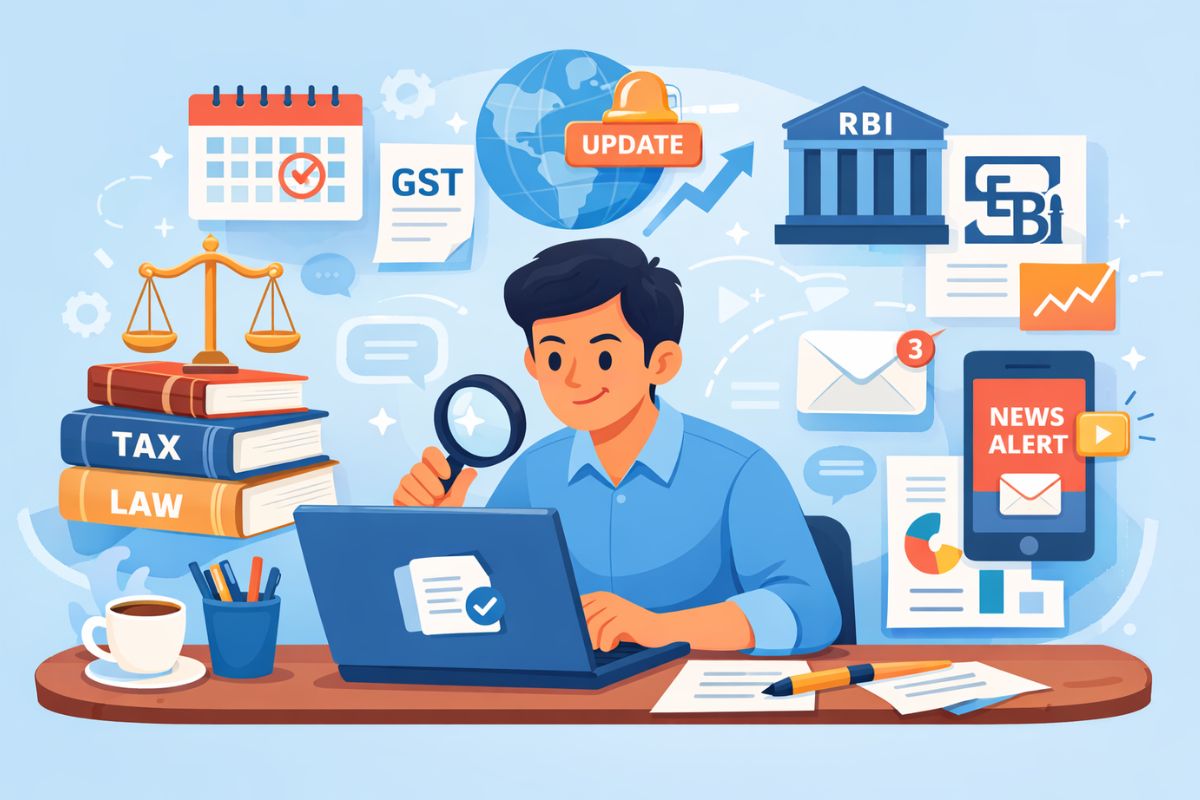
If you are studying CA, doing articleship, or already working as a professional, one thing is very clear — law and finance keep changing all the time.
Every year:
- Tax rules change
- GST rules are updated
- Company law is amended
- New compliance is added
- Court decisions change how law is applied
If you do not stay updated, you may feel confused, stressed, or even scared at work. Many students and professionals feel the same, especially when English is not strong or time is limited.
This article will help you understand how you can stay updated step by step, in a simple, practical, and stress-free way — even if you are busy or not very confident in English.
Why Staying Updated Is Not Optional Anymore
Earlier, professionals could rely on old knowledge for many years. That is not possible today.
If you work with old information:
- You may file wrong returns
- You may follow outdated procedures
- You may give wrong advice to clients
- You may fail in interviews
- You may lose confidence at work
Law and finance professionals are trusted because they are correct and updated. Even a small mistake can create penalties, notices, or client loss.
Staying updated is not about becoming an expert in everything.
It is about knowing what has changed and how it affects your work.
Understand First: You Do NOT Need to Know Everything
This is where most people get scared.
You do not need to:
- Read full Acts every day
- Read every court judgment
- Follow all finance news
You only need to track relevant changes related to:
- Your course
- Your job
- Your area of work
For example:
- If you work in tax → focus on Income Tax and GST
- If you work in audit → focus on accounting standards and ICAI updates
- If you work in corporate → focus on MCA, SEBI, and RBI rules
Clarity reduces stress.
Steps to Stay Updated With Law & Finance Changes as a Professional
Step 1: Start With Official and Trusted Sources
Official sources are the most reliable. Social media may explain things, but official sources confirm the truth.
ICAI Updates (Very Important for CAs)
The Institute of Chartered Accountants of India regularly releases:
- Announcements
- Notifications
- Guidance notes
- Accounting standard updates
- Ethical and disciplinary updates
These updates directly affect:
- Exams
- Articleship
- Audit practice
- Professional conduct
Even if language feels difficult, you should:
- Read the heading
- Read the summary
- Note the effective date
Over time, your understanding will improve.
Government Portals You Must Track
Depending on your work, these portals matter a lot:
- Income Tax Department website
- GST portal
- Ministry of Corporate Affairs (MCA)
They publish:
- Notifications
- Circulars
- Due date changes
- Procedure updates
You do not need to read full notifications. Focus on:
- What changed
- From when it applies
- Who it applies to
RBI and SEBI (For Finance & Corporate Roles)
If you are working in banking, finance, or corporate roles, updates from
Reserve Bank of India and
Securities and Exchange Board of India are very important.
These affect:
- NBFCs
- Listed companies
- Investors
- Corporate compliance
Many students ignore these and later struggle in interviews.
Step 2: Use Newsletters to Save Time
You cannot visit 5–6 websites daily. That is why newsletters are very useful.
A good newsletter:
- Explains updates in simple English
- Saves your time
- Filters unnecessary information
- Focuses on practical impact
How You Should Use Newsletters
- Subscribe to only 2–3 good newsletters
- Read them daily for 10–15 minutes
- Save important emails in folders
- Revise once a week
Do not subscribe to too many newsletters. Too much information creates confusion.
Step 3: Learn Through Simple Explanations (Not Heavy Language)
Many official updates are written in difficult English. That is normal.
To understand them better:
- Read explainer articles
- Watch simple videos
- Follow professionals who explain in easy words
Why Simple Explanation Matters
- You understand faster
- You remember longer
- You can explain to others
- You gain confidence
Understanding is more important than memorising.
Step 4: Use LinkedIn the Right Way
LinkedIn can be very helpful if used correctly.
Who You Should Follow
- Senior CAs
- Tax consultants
- Audit professionals
- Law firms
- Compliance experts
They often:
- Explain law changes
- Share real case experiences
- Discuss practical impact
Who You Should Avoid
- Influencers promising shortcuts
- People creating panic posts
- Unverified legal pages
Always ask yourself:
“Is this person qualified to explain this?”
Step 5: Learn Case Laws Smartly (Not Fully)
Many students fear case laws. You do not need to.
You should:
- Read case summaries, not full judgments
- Focus on:
- Issue
- Decision
- Practical impact
Case laws help you understand how law works in real life.
They improve:
- Logical thinking
- Application skills
- Interview answers
Step 6: Create a Simple Weekly Update Routine
Without routine, updates become irregular.
Simple Routine Anyone Can Follow
Monday to Friday
- Read updates for 10–15 minutes
- Focus on only one area
Saturday
- Revise important changes of the week
- Note down key points
Sunday
- Read one detailed article or watch one explanation video
This habit is more powerful than last-minute study.
Step 7: Maintain Your Own Notes (Very Important)
Reading alone is not enough. You must record what you learn.
Your notes should include:
- What changed
- Old rule vs new rule
- Effective date
- Practical impact
These notes help:
- During exams
- During client work
- During interviews
- During revisions
Keep notes simple. Do not write big paragraphs.
Step 8: Learn From Practical Work
Your office work itself teaches you many updates.
Whenever you:
- File a return
- Handle GST compliance
- Prepare audit reports
- Draft documents
You face:
- New forms
- Changed procedures
- Updated portals
Do not ignore these moments. Ask questions. Understand why changes happened.
Step 9: Be Careful With WhatsApp & Telegram Groups
Groups can help, but they can also mislead.
Good Groups:
- Office groups
- ICAI official groups
- Groups run by professionals
Bad Groups:
- Forward-only groups
- Panic-creating groups
- Fake notification groups
Never trust forwarded messages without checking official sources.
Common Mistakes You Must Avoid
Many students and professionals fail because of these mistakes:
- Waiting for seniors to inform
- Relying only on social media
- Ignoring small updates
- Studying only during exams
- Thinking updates are “not important now”
Updates affect your career slowly but strongly.
How Staying Updated Improves Your Career
When you stay updated:
- You answer better in interviews
- You perform confidently at work
- Seniors trust your judgment
- Clients respect your advice
- You stand out from others
Knowledge builds reputation. Reputation builds career.
Final Thoughts
Staying updated with law and finance changes is not difficult if done correctly.
You do not need:
- Perfect English
- Many hours
- Deep legal books
You only need:
- Consistency
- Right sources
- Simple understanding
- Practical notes
Even 15 minutes daily can change your professional future.
Start today. Small steps create big confidence.
Calling all CA dreamers!
🔴 Are you tired of searching for the perfect articelship or job?
Well, fear no more! With 10K+ students and professionals already on board, you don't want to be left behind. Be a part of the biggest community around! Join the most reliable and fastest-growing community out there! ❤️
And guess what? It’s FREE 🤑
✅ Join our WhatsApp Group (Click Here) and Telegram Channel (Click Here) today for instant updates.