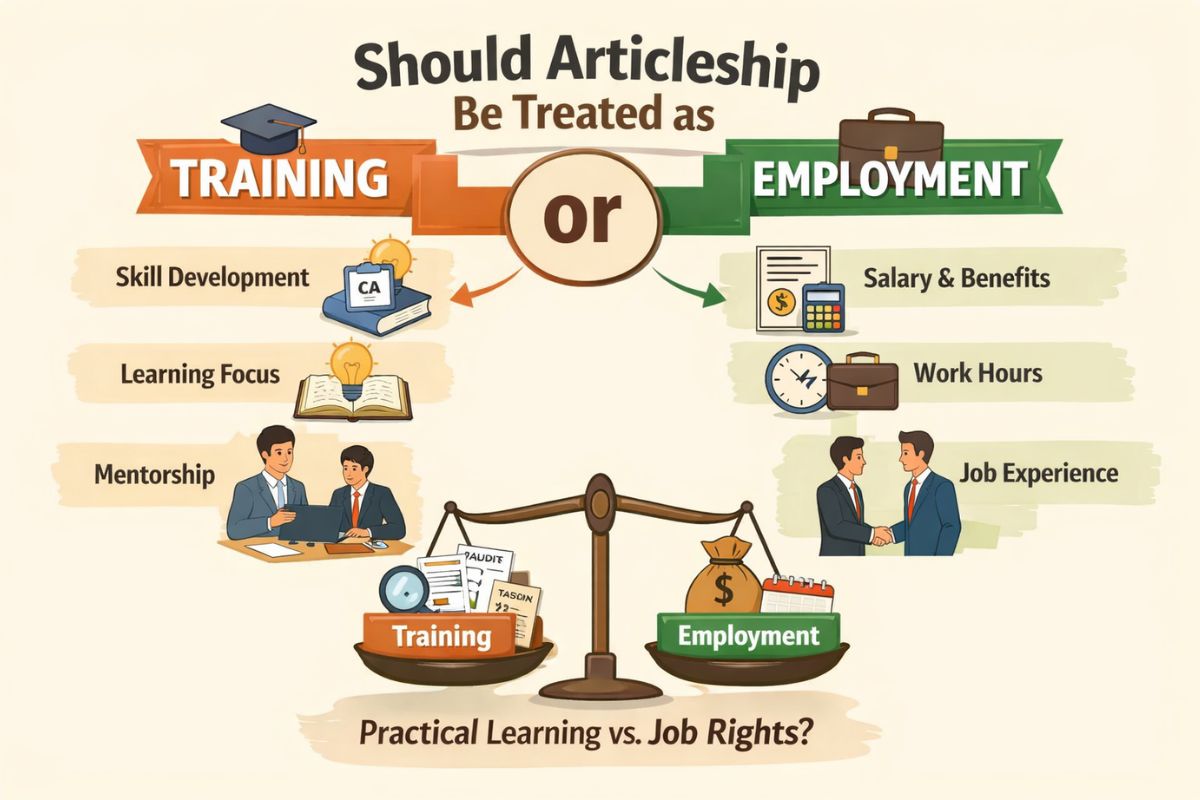
If you are pursuing Chartered Accountancy, one question will definitely cross your mind at some point: Should articleship be treated as training or employment?
You work full-time. You follow office timings. You receive a stipend. Sometimes, you even handle responsibilities similar to paid employees.
Then why is it called “training”?
In this detailed guide, let us understand the real nature of articleship, how ICAI views it, how firms treat it, and what it practically means for your career.
What Is Articleship Under the CA Course?
Articleship is a mandatory practical training period prescribed by ICAI as part of the CA course. Without completing it, you cannot qualify as a Chartered Accountant.
It usually lasts for three years (as per the current scheme), and during this period:
- You work under a practicing Chartered Accountant.
- You gain exposure to audit, taxation, GST, company law, compliance, and accounting.
- You apply theoretical knowledge to real-life cases.
The core objective is clear: to convert a CA student into a competent professional through structured practical exposure.
So technically and regulatorily, articleship is designed as training.
But the confusion arises because of how it feels in reality.
Why Does Articleship Feel Like Employment?
If you are doing articleship, you probably:
- Follow regular office hours.
- Report to seniors and partners.
- Handle clients independently after a point.
- Travel for audit assignments.
- Meet deadlines and performance expectations.
- Receive a monthly stipend.
All of this makes it feel very similar to employment.
In many firms, especially mid-sized and large firms, the work pressure and expectations from articles can be as high as that from junior employees.
So naturally, you start wondering — if I am working like an employee, why am I not treated as one?
How Does ICAI Legally Classify Articleship?
From a regulatory perspective, articleship is not employment.
It is a training contract governed by ICAI regulations, not labour laws.
Here are some important distinctions:
- You sign Articleship Form 102/103 (training agreement), not an employment contract.
- You receive a stipend fixed as per ICAI norms, not a salary negotiated freely.
- You are not entitled to employee benefits like PF, gratuity, bonus, or other statutory benefits.
- Your leaves are regulated by ICAI training rules.
This clearly shows that legally and structurally, articleship is training.
But this does not mean your work is less valuable.
What Is the Core Objective of Articleship?
The main purpose of articleship is learning through practice.
Unlike a normal job where the employer hires you to generate revenue or complete work, articleship is designed to:
- Train you in practical professional skills.
- Help you understand real business situations.
- Teach you client handling and communication.
- Develop analytical thinking.
- Build professional ethics and discipline.
Even though firms benefit from your work, the primary intention of the framework is educational.
This is why articleship is compulsory. It is not optional like an internship.
Should Articleship Be Treated as Training?
Yes — from a structural and regulatory standpoint, articleship is training.
Here’s why:
It Is Mandatory for Qualification
You cannot become a CA without completing articleship. This makes it part of the curriculum, not an optional job.
It Is Designed for Skill Development
The focus is supposed to be on learning different areas such as audit, GST, income tax, and corporate laws. The expectation is that you rotate and gain exposure, not just perform repetitive clerical work.
It Is Time-Bound and Structured
Articleship has defined tenure, leave rules, transfer conditions, and completion formalities. These are educational regulations, not employment policies.
It Is Supervised Training
You work under a principal (CA), who is responsible for guiding and training you. This mentor-like structure supports the idea of training.
So conceptually, it is training.
Then Why Do Many Students Feel It Is Employment?
Because in practice, things are not always ideal.
In some firms:
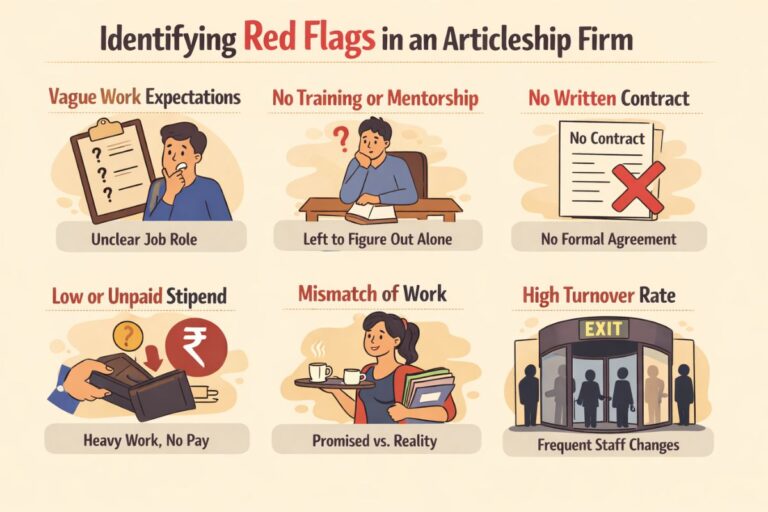
- Articles are given routine tasks without proper explanation.
- Long working hours are common during audit season.
- Exposure may be limited to only one area.
- Learning is sometimes secondary to work completion.
When this happens, you start feeling like cheap labour instead of a trainee.
But remember, this is an issue of implementation — not of design.
The system calls it training. The experience depends largely on the firm you choose.
Can Articleship Be Considered Work Experience?
This is an important practical question.
When you apply for:
- Campus placements
- Industry jobs
- MBA admissions
- Other professional roles
Your articleship is usually treated as professional training experience, not formal employment.
However, in the CA ecosystem, articleship carries huge value.
Recruiters understand:
- You have handled audits.
- You have dealt with taxation filings.
- You have worked with clients.
- You understand compliance deadlines.
So while it may not be classified as “employment” in HR terms, it is highly respected as professional exposure.
In fact, for a CA student, articleship is your strongest practical foundation.
What Happens If Articleship Is Treated Like Employment?
Let us imagine that articleship was legally treated as employment.
This would mean:
- Firms would need to provide full labour law benefits.
- Stipend would likely increase significantly.
- Employment contracts would replace training agreements.
- Disputes would fall under labour courts.
While this may seem attractive at first, it could create challenges:
- Small firms may stop taking articles due to higher compliance costs.
- Exposure opportunities might reduce.
- The learning-oriented flexibility could decrease.
- The focus may shift from mentoring to productivity.
So converting articleship into employment might not be as simple as it sounds.
What Should You Focus On During Articleship?
Instead of worrying too much about the label, focus on how you can maximise your training.
Here is how you can approach articleship practically:
- Choose your firm wisely. Before joining, try to understand what kind of exposure you will get. Talk to existing articles if possible.
- Take initiative in learning. Do not wait for someone to teach you everything. Ask questions and request diverse work.
- Maintain documentation of your work. Keep a record of assignments handled. This helps in interviews later.
- Develop communication skills. Client interaction is a major benefit of articleship. Use it to build confidence.
- Understand the “why” behind tasks. Do not just complete working papers — try to understand the reasoning.
If you treat articleship seriously as a learning phase, it will benefit you for years.
Is the Stipend Proof That It Is Employment?
Not necessarily.
The stipend is meant to support you financially during training. It is not structured as a salary.
In employment:
- Salary is negotiated based on market value.
- Annual increments are expected.
- Employee benefits are included.
In articleship:
- Stipend is regulated.
- It is generally modest.
- It reflects trainee status.
So the presence of payment does not automatically make it employment.
Many professional courses provide stipends during training phases. That does not convert them into jobs.
What Is the Balanced View?
The most practical answer is this:
Articleship is legally training, but functionally it may resemble employment in many firms.
Both realities exist together.
As a CA aspirant, it is important to understand:
- The system considers you a trainee.
- The firm may expect you to perform like a junior professional.
- The real value lies in what you learn, not in what it is called.
If you go into articleship thinking it is just a job, you may feel underpaid.
If you go into it understanding it is professional training, you will focus on skill development.
Your mindset makes a big difference.
What Should ICAI and Firms Improve?
While articleship is designed as training, improvements are always possible:
- Firms should ensure real learning exposure, not repetitive work.
- Structured mentoring sessions can improve quality of training.
- Transparent work allocation can help articles grow faster.
- Stipend norms can be periodically reviewed to match inflation.
Better implementation can bridge the gap between theory and practice.
Conclusion: Training or Employment?
So, should articleship be treated as training or employment?
The clear answer is: Articleship is training by design and regulation, even though it may feel like employment in practice.
As a CA aspirant, you should:
- View articleship as your professional foundation.
- Focus on gaining maximum exposure.
- Treat it seriously, but not emotionally.
- Use it as a stepping stone for your long-term career.
At the end of the day, the three years of articleship shape you more than any exam.
If you use this period wisely, it will not matter whether it was called training or employment — it will become your strongest professional asset.
Calling all CA dreamers!
🔴 Are you tired of searching for the perfect articelship or job?
Well, fear no more! With 10K+ students and professionals already on board, you don't want to be left behind. Be a part of the biggest community around! Join the most reliable and fastest-growing community out there! ❤️
And guess what? It’s FREE 🤑
✅ Join our WhatsApp Group (Click Here) and Telegram Channel (Click Here) today for instant updates.