If you are a CA student, commerce student, or someone at the early stage of your finance career, this question surely comes to your mind:
“What exactly is the difference between audit, taxation, and advisory work?”
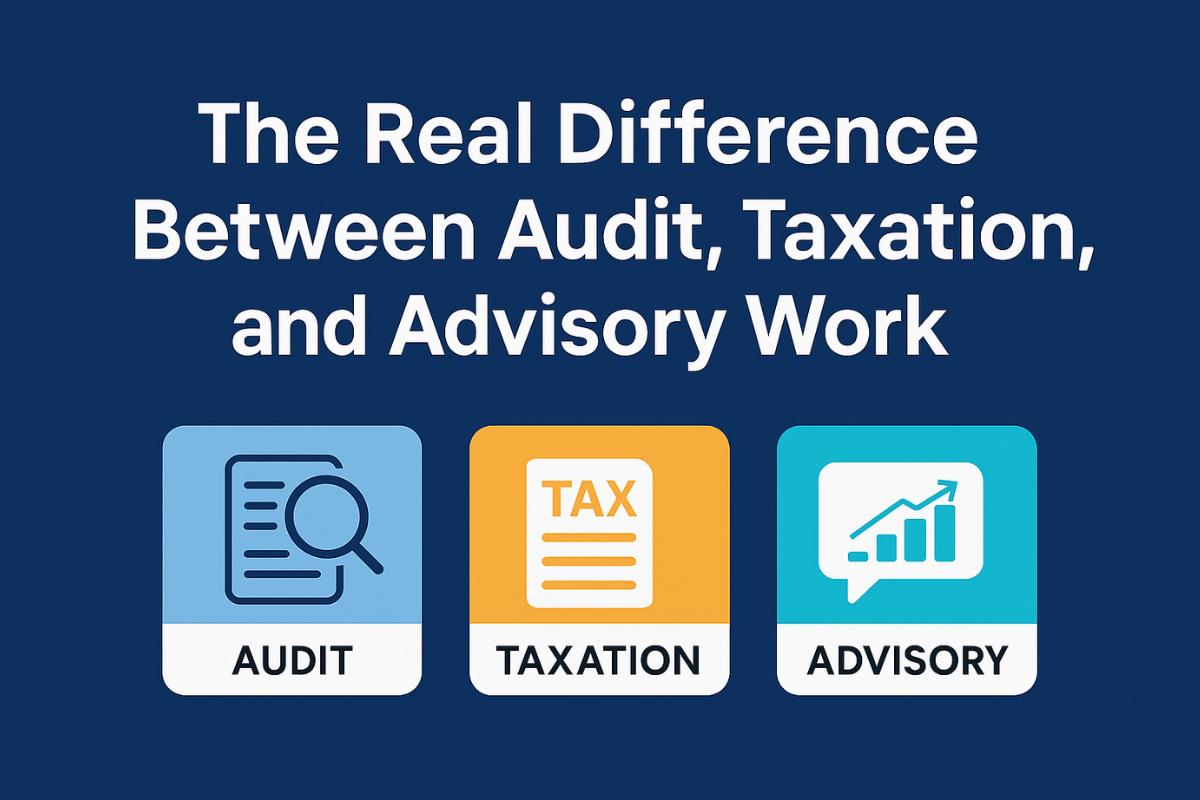
From outside, all three may look similar. You may feel that everything revolves around numbers, reports, and compliance. But once you enter a firm or start articleship, you realise that audit, tax, and advisory are completely different worlds.
This article explains the real difference between these three areas in simple English, keeping your mindset in mind. By the end, you will clearly know:
- What work you actually do in each field
- What skills each area needs
- What kind of person fits where
- Which option may suit you better in the long run
Why You Should Understand This Difference Early
Many students choose their articleship or job blindly. Later, they feel stuck or demotivated.
You should understand:
- What daily work looks like
- Whether the role is routine or thinking-based
- Whether it suits your personality
- What career growth looks like
Choosing the right domain early saves you years of confusion.
Let us break it down one by one.
What Is Audit Work (In Real Life)?
What audit actually means
Audit work is mainly about checking and verifying. You check whether financial records are correct, complete, and prepared as per law and standards.
Think of audit as answering one simple question:
“Are these numbers trustworthy?”
What you actually do in audit
If you join audit, your daily work may include:
- Checking vouchers, invoices, bills, and expenses
- Verifying bank statements and balances
- Matching books of accounts with supporting documents
- Testing internal controls of the company
- Ensuring compliance with accounting standards and laws
- Preparing audit working papers
- Assisting in drafting audit reports
In simple words, you examine past data and confirm whether it is correct.
Nature of audit work
- Very process-driven
- Structured and rule-based
- Repetitive at junior levels
- Heavy documentation
- Fixed timelines, especially during audit season
Skills needed for audit
Audit is ideal for you if:
- You like rules and checklists
- You are patient and detail-oriented
- You don’t mind repetitive work
- You can work long hours during peak season
Audit teaches discipline, documentation, and compliance thinking.
What Is Taxation Work (In Real Life)?
What taxation actually means
Taxation work is about calculating, planning, and paying tax correctly according to law.
The core question here is:
“How much tax is payable, and how can it be legally optimised?”
What you actually do in taxation
In tax work, you may handle:
- Income tax return filing (individuals and companies)
- GST returns (GSTR-1, GSTR-3B, reconciliation)
- TDS calculations and returns
- Tax audits and reports
- Replying to income tax or GST notices
- Tax planning for businesses and individuals
- Advising on deductions, exemptions, and compliance
Here, you don’t just check numbers. You apply law to numbers.
Nature of taxation work
- Law-oriented
- Deadline-driven
- Changes frequently with amendments
- Requires interpretation and application of law
- Less fieldwork compared to audit
Skills needed for taxation
Tax is suitable for you if:
- You enjoy reading and interpreting law
- You like problem-solving
- You can keep up with changing provisions
- You are comfortable with calculations
- You like advisory-oriented thinking within law
Taxation gives strong long-term relevance because tax law always evolves.
What Is Advisory Work (In Real Life)?
What advisory actually means
Advisory work is about giving solutions and guidance, not just compliance.
The key question here is:
“What is the best decision going forward?”
This is future-focused work.
What you actually do in advisory
Advisory covers a wide range of work, such as:
- Business restructuring and strategy
- Financial planning and budgeting
- Mergers & acquisitions support
- Due diligence
- Risk management
- Startup advisory
- Compliance planning, not just filing
- Process improvement
Here, you use audit and tax knowledge together to help businesses make smart decisions.
Nature of advisory work
- Thinking-oriented
- Less routine
- Client-facing
- Depends heavily on judgement
- Project-based, not repetitive
Skills needed for advisory
Advisory is good for you if:
- You like analysing problems
- You enjoy discussions and decision-making
- You think beyond books and compliance
- You are comfortable interacting with clients
- You like variety in work
Advisory roles usually come after some experience in audit or tax.
Simple Comparison: Audit vs Tax vs Advisory
| Aspect | Audit | Taxation | Advisory |
| Focus | Verification | Compliance & planning | Strategy & solutions |
| Time focus | Past | Past & present | Future |
| Nature | Rule-based | Law-based | Judgement-based |
| Routine | High | Medium | Low |
| Client interaction | Limited | Medium | High |
| Creativity | Low | Medium | High |
| Risk | Low | Medium | Higher responsibility |
Which One Is Better for Articleship?
There is no “best” option for everyone. It depends on what kind of professional you want to become.
Choose audit if
- You want strong fundamentals
- You want to understand business processes
- You don’t mind structured work
- You aim for corporate roles later
Audit gives a strong base but may feel monotonous initially.
Choose taxation if
- You are comfortable with law
- You enjoy interpretation
- You want specialised long-term knowledge
- You enjoy compliance mixed with advisory
Tax builds strong individual value and expertise.
Choose advisory if
- You already have basic exposure
- You enjoy analysis and problem-solving
- You want dynamic work
- You aim for consulting or strategy roles
Advisory is generally not entry-level but highly rewarding.
Career Growth in Each Field
Growth in audit
- Articleship → Audit senior → Manager
- Exit options into corporate finance, internal audit, compliance
- Good for governance and risk roles
Growth in tax
- Articleship → Tax consultant → Senior tax advisor
- Can build independent practice
- Strong relevance in every business
Growth in advisory
- Analyst → Consultant → Senior advisor
- Faster learning curve
- Exposure to high-level decision-making
Salary and Work Pressure Reality
- Audit: High workload during season, moderate long-term pay
- Tax: Consistent workload throughout the year, stable growth
- Advisory: Higher pay potential but higher responsibility
Remember, learning matters more than salary at the start.
A Common Mistake You Should Avoid
Many students choose a field because:
- Friends are joining it
- Big firm name sounds attractive
- Someone says “this has more scope”
Instead, ask yourself:
- What kind of work can you do daily without frustration?
- Do you like rules, law, or strategy?
- Do you prefer routine or thinking work?
Your personality matters more than hype.
Can You Switch Later?
Yes, absolutely.
Many professionals:
- Start with audit and move to advisory
- Start with tax and become consultants
- Use audit + tax experience for advisory roles
Your initial choice is important, but not permanent.
Final Thoughts
Audit, taxation, and advisory are not just different departments. They are different ways of thinking.
- Audit builds discipline
- Tax builds legal understanding
- Advisory builds strategic mindset
There is no single right path. The right path is the one that matches you.
Choose wisely, learn deeply, and stay curious. Your career will slowly shape itself around the skills you build today.
Calling all CA dreamers!
🔴 Are you tired of searching for the perfect articelship or job?
Well, fear no more! With 10K+ students and professionals already on board, you don't want to be left behind. Be a part of the biggest community around! Join the most reliable and fastest-growing community out there! ❤️
And guess what? It’s FREE 🤑
✅ Join our WhatsApp Group (Click Here) and Telegram Channel (Click Here) today for instant updates.