When you think about becoming a Chartered Accountant (CA), the first thing that usually comes to mind is technical knowledge. You picture accounting standards, audit procedures, tax laws, GST rules, and endless study hours. And that is true—technical knowledge is the backbone of your CA journey.
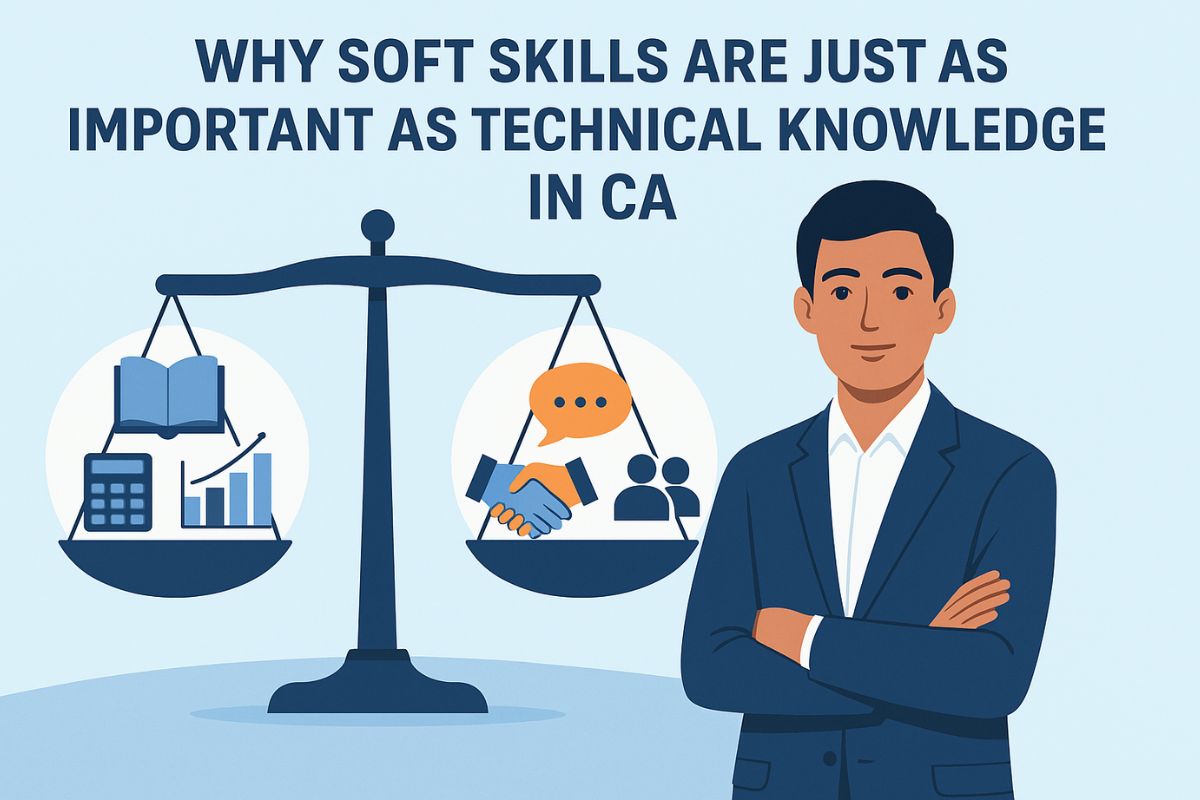
But here’s something most students realise only later: soft skills are just as important as technical knowledge in CA. In fact, the higher you grow in your career, the more soft skills decide your success.
If you want to stand out, get better opportunities, build strong relationships, and become a trusted professional, then you must balance both—your technical knowledge and your soft skills.
This article will help you understand why soft skills matter so much, how they shape your CA journey, and what you can start doing today to improve them.
Technical Knowledge Makes You a CA, But Soft Skills Make You a Successful CA
When you pass CA exams, you prove that you understand accounting, auditing, law, direct tax, indirect tax, financial reporting, costing, and more. This knowledge gives you your identity as a professional.
But technical knowledge alone doesn’t guarantee success.
As you grow, you’ll realise that your work is not just about solving numbers. It’s about solving people’s problems using those numbers.
Whether you work in a firm, a company, or start your own practice, you will deal with people daily—clients, teams, seniors, juniors, vendors, bankers, and sometimes even government officers.
If you cannot communicate, explain, negotiate, or manage relationships, then even the best technical knowledge will not help you build a strong career.
You Need Soft Skills to Explain Complex Concepts Simply
One of the biggest responsibilities of a CA is explaining complicated financial matters in a simple and clear way.
Clients don’t understand accounting terms. Managers don’t always know financial jargon. Many business owners come from non-finance backgrounds.
You must be able to explain concepts like:
- depreciation
- re-assessment
- GST input mismatches
- audit observations
- cashflow problems
- tax planning opportunities
in a way that anyone can understand.
If you can explain things clearly, confidently, and calmly, you instantly build trust. People start seeing you as someone who understands their business—not just their balance sheet.
Soft Skills Help You During Articleship More Than You Expect
During articleship, you will interact with:
- clients
- employees
- seniors
- managers
- partners
Some will be friendly, some will be strict, some will not cooperate, and some may even get irritated with your questions.
This is where soft skills matter the most.
You need soft skills to:
- ask doubts without sounding unsure
- handle pressure
- communicate respectfully
- manage your time
- work in teams
- understand instructions
- get work done even when people are busy
- adapt to new situations
- stay calm when something goes wrong
If you only focus on technical learning but ignore your people skills, articleship becomes more stressful and less fruitful.
As You Grow, Your Role Becomes More About People and Less About Paperwork
At the beginning of your career, you do a lot of technical tasks:
- vouching
- tallying
- filing returns
- preparing working papers
- drafting reports
But as you become senior, your role changes completely.
You spend more time on:
- supervising teams
- reviewing drafts
- guiding juniors
- meeting clients
- presenting reports
- discussing financial decisions
- resolving disputes
- managing deadlines
These tasks require confidence, clarity, patience, leadership, and emotional intelligence.
Without strong soft skills, you will always stay stuck at the technical level while others move ahead.
Communication Skills Decide Whether Clients Trust You
A client doesn’t know how many hours you worked.
A client doesn’t know how complicated the audit was.
A client doesn’t know the level of detail you checked.
But a client knows how you speak, how you explain, and how you make them feel.
If you can communicate well, clients will:
- respect you
- trust your advice
- give you more work
- recommend you to others
But if your communication is weak, even your best work may go unnoticed.
Your soft skills help people see your value. Your technical skills help you deliver that value.
You need both.
Soft Skills Build Your Leadership Qualities
Leadership is not only for partners or managers. Leadership starts the day you join articleship.
When you guide an intern, when you handle a small assignment, when you represent your team in front of a client—you are already practising leadership.
Leadership requires:
- confidence
- responsibility
- problem-solving
- teamwork
- self-discipline
- decision-making
These are all soft skills.
Strong leadership skills help you climb the ladder faster. They help you become a go-to person in your team. They help you earn respect without demanding it.
Your Soft Skills Impact How You Handle Pressure
The CA journey is long, challenging, and full of ups and downs.
There will be moments when:
- you feel overwhelmed
- you face last-minute complications
- you get negative feedback
- you struggle to finish work on time
- clients pressure you
- seniors expect more
- you feel lost or frustrated
Handling pressure is a soft skill.
When you learn how to communicate clearly, organise your time, break work into steps, and maintain emotional balance, you become more productive and confident.
Technical knowledge helps you solve the problem. Soft skills help you stay calm while solving it.
Soft Skills Decide Your Growth in Corporate Roles
If you join a company as a CA, your work will not be just preparing statements. You will be part of meetings, discussions, negotiations, budgeting sessions, risk assessments, and strategic planning.
To grow in corporate roles, you need strong soft skills:
- analytical thinking
- presentation skills
- confidence while speaking
- understanding business needs
- teamwork
- problem-solving
- management skills
These qualities help you get promotions, lead teams, and handle bigger responsibilities.
Soft Skills Are Essential If You Want to Start Your Own Practice
If your dream is to open your own CA firm, then your soft skills decide everything:
You need soft skills to:
- attract clients
- understand their expectations
- negotiate fees
- deliver reports on time
- communicate clearly
- handle conflicts
- build a network
- manage your team
- build your brand
- create trust in the market
Your practice grows because people trust you first before they trust your technical abilities.
Soft Skills Make You Future-Ready in a Changing CA Industry
Today, automation, AI, and software are doing many tasks that junior CAs used to do earlier.
This means routine tasks will slowly reduce and advisory roles will increase.
Future CAs will focus more on:
- financial analysis
- strategic consulting
- risk assessment
- business planning
- performance evaluation
All these roles depend heavily on soft skills such as communication, critical thinking, adaptability, and creative problem-solving.
The more soft skills you develop, the more irreplaceable you become—because machines cannot replace human communication, trust, empathy, and judgment.
The Most Important Soft Skills for CAs (And How You Can Improve Them)
Communication Skills
To explain things clearly, write reports well, and speak with confidence.
How to improve:
- practice explaining concepts to others
- participate in discussions
- write summaries of your work
- record yourself speaking and review
Time Management
To manage deadlines and multiple tasks.
How to improve:
- plan your day
- prioritise important work
- break big tasks into small tasks
- avoid multitasking
Teamwork
To work smoothly with clients, colleagues, and seniors.
How to improve:
- listen before reacting
- support others
- share knowledge
- give credit to others
Problem-Solving
To find practical solutions instead of only identifying problems.
How to improve:
- ask “why” more often
- analyse root causes
- brainstorm multiple options
- learn from past mistakes
Presentation Skills
To confidently present your work.
How to improve:
- practise presenting in front of a mirror
- start with short presentations
- create simple slides
- focus on clarity, not fancy design
Adaptability
To handle new situations, new rules, and new technologies.
How to improve:
- stay open-minded
- learn new tools
- say “yes” to new challenges
- keep updating your skills
Professional Behaviour
To build trust and maintain credibility.
How to improve:
- be punctual
- stay polite
- maintain ethics
- communicate respectfully
Balancing Soft Skills and Technical Knowledge Makes You Unstoppable
The best CA professionals are not the ones who know everything.
They are the ones who can:
- explain things clearly
- solve problems
- build relationships
- make good decisions
- guide others
- stay calm under pressure
- understand business needs
- communicate with confidence
When you combine strong technical knowledge with strong soft skills, you become a complete professional.
Final Thoughts
If you want to grow in your CA journey—not just get a job, but truly build a successful career—focus on both technical and soft skills.
Your technical knowledge helps you do your work.
Your soft skills help people value your work.
Start investing in your soft skills today. They are not optional. They are your secret weapon for a long, confident, and rewarding CA career.
Calling all CA dreamers!
🔴 Are you tired of searching for the perfect articelship or job?
Well, fear no more! With 10K+ students and professionals already on board, you don't want to be left behind. Be a part of the biggest community around! Join the most reliable and fastest-growing community out there! ❤️
And guess what? It’s FREE 🤑
✅ Join our WhatsApp Group (Click Here) and Telegram Channel (Click Here) today for instant updates.