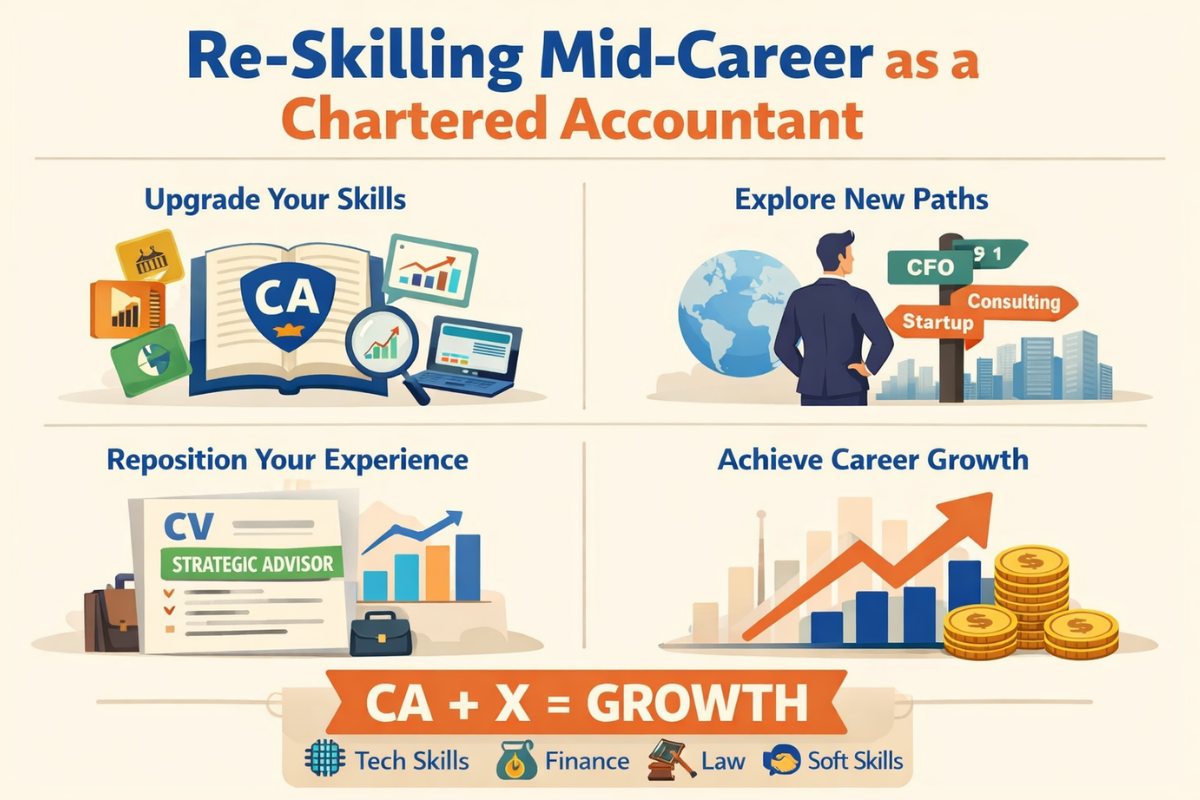
Many Chartered Accountants reach a stage in their career where growth starts slowing down. Work becomes repetitive, mostly compliance-driven, and the learning curve flattens. At this point, you may start asking yourself a very important question: What next?
This is exactly where re-skilling becomes crucial.
Re-skilling mid-career as a Chartered Accountant is not about changing your profession. It is about upgrading your skills so that you can move into better roles, earn more, and stay relevant in a changing market.
This article will help you understand how to approach re-skilling in a practical and structured way.
Why Should You Think About Re-skilling Mid-Career?
The CA profession is evolving fast. Earlier, most work revolved around audit, taxation, and compliance. Today, technology and automation are handling a large part of that work.

So what is changing for you?
- Compliance work is becoming automated, which reduces its long-term value. If you continue doing only routine work, growth will become limited over time.
- Companies are now looking for professionals who can help in decision-making, not just reporting. This means your role needs to move from execution to strategy.
- New areas like data analytics, fintech, and global finance are opening up, but they require additional skills.
If you do not adapt, you may feel stuck. But if you re-skill smartly, you can unlock completely new opportunities.
How to Choose the Right Direction Before Re-skilling?
Before you start any course or certification, you need clarity. Many CAs make the mistake of jumping into random courses without knowing their end goal.
Start by asking yourself:
- Do you want a higher salary role in corporate?
- Do you want to reduce compliance work and move into strategy?
- Do you want to start your own specialised practice?
- Do you want to switch into finance, consulting, or startups?
Your answers will decide your path.
Common career directions you can consider
- Corporate finance and CFO track where you handle budgeting, strategy, and decision-making
- Consulting roles where you advise clients on business, tax, or transactions
- Investment banking and valuation where financial modelling plays a key role
- Specialised practice like GST litigation, forensic audit, or international taxation
- Startup roles where you work closely with founders on finance and growth
Clarity at this stage saves you time, money, and effort later.
What Skills Should You Focus on for Re-skilling?
Instead of thinking in terms of courses, think in terms of skill areas. This makes your approach more practical and result-oriented.
Tech and Data Skills
This is the biggest gap for most mid-career CAs.
You should focus on:
- Advanced Excel and tools like Power BI or Tableau, which help you analyse and present data effectively
- Basic understanding of SQL so that you can handle financial data independently
- Use of AI tools like ChatGPT to improve productivity in reporting, analysis, and documentation
These skills help you move from preparing data to interpreting data, which is where real value lies.
Financial and Strategic Skills
If you want to move beyond compliance, you need to understand business from a strategic angle.
You can focus on:
- Financial modelling, which helps you evaluate companies and projects
- Valuation techniques used in mergers, acquisitions, and investments
- Understanding how businesses make decisions based on financial data
These skills open doors to roles in corporate finance, consulting, and investment banking.
Domain Specialisation
One of the smartest ways to grow is to become an expert in a specific area.
Some high-demand niches include:
- International taxation, where you deal with cross-border transactions and complex regulations
- GST litigation, which requires both technical knowledge and practical exposure
- Forensic audit, where you investigate financial irregularities and frauds
- ESG and sustainability reporting, which is a growing field globally
Specialisation helps you stand out and charge higher fees or command better salaries.
Legal and Compliance Knowledge
Adding a legal edge to your CA qualification can be very powerful.
You can explore:
- Basic corporate law knowledge or even LLB if you are interested
- Understanding regulatory frameworks and compliance requirements in depth
This combination is especially useful for roles in governance, compliance, and advisory.
Soft Skills That Actually Matter
Many CAs ignore this, but this is often the real reason behind slow growth.
You should work on:
- Communication skills so that you can explain financial concepts to non-finance people
- Presentation skills to confidently share your ideas in meetings
- Client handling and negotiation skills, especially if you are in practice
At mid-career level, growth is not just about knowledge. It is about how well you can apply and present it.
Should You Do Additional Courses or Certifications?
Courses can help, but only if they are aligned with your goals.
Here are some options you can consider:
- CFA if you want to move into investment banking or finance roles
- FRM if you are interested in risk management
- Financial modelling courses for practical finance skills
- Data analytics certifications to strengthen your tech profile
- MBA if you want a major shift into management or leadership roles
The key is not to collect certificates. The key is to build skills that can be applied in real work.
How Can You Reposition Your Existing Experience?
This is one of the most important steps and often ignored.
You already have valuable experience. The problem is how you present it.
For example:
Instead of saying that you worked in audit, you can say that you identified financial risks and improved internal controls for clients. This shows impact.
Instead of saying that you handled tax returns, you can say that you helped clients optimise their tax liabilities and ensured compliance.
Small changes in how you present your work can make a big difference in how others perceive your profile.
How to Create a Practical Transition Plan?
Re-skilling should not be rushed. You should follow a structured approach.
Phase 1: Learning Stage
Spend a few months learning your chosen skill. Focus on understanding concepts and doing small practical exercises.
Phase 2: Application Stage
Try to apply your new skills in your current role. For example, if you learn data analytics, start using it in your existing work.
Phase 3: Transition Stage
Once you gain confidence, start applying for roles or clients where these skills are required.
This approach reduces risk and helps you build confidence step by step.
What New Opportunities Can You Explore After Re-skilling?
Once you upgrade your skills, you are not limited to traditional CA roles anymore.
You can explore:
- Advisory roles where you act as a strategic partner for businesses
- Virtual CFO services where you work with multiple clients and help them manage finances
- Startup roles where you are involved in fundraising, planning, and execution
- Global opportunities like remote accounting and international consulting
- Content creation and teaching where you share your knowledge and build a personal brand
The scope becomes much wider when you combine your CA qualification with new skills.
What Mistakes Should You Avoid While Re-skilling?
To make your journey smoother, avoid these common mistakes:
- Starting courses without clarity, which leads to wasted time and money
- Staying only in compliance roles without trying to learn new skills
- Ignoring technology, which is becoming essential in every role
- Not working on communication skills, which limits your growth
- Expecting instant results instead of focusing on long-term improvement
Being aware of these mistakes helps you take better decisions.
Conclusion
Re-skilling mid-career as a Chartered Accountant is not about changing your identity. It is about evolving with the profession.
You already have a strong foundation. What you need now is the right combination of skills, direction, and execution.
If you focus on the right areas, position your experience well, and take a structured approach, you can move from routine work to high-value roles.
Remember this simple idea:
Your CA qualification is your base. Your additional skills decide how far you go.
Start small, stay consistent, and keep learning. That is how real career growth happens.
Calling all CA dreamers!
🔴 Are you tired of searching for the perfect articelship or job?
Well, fear no more! With 15,000+ students and professionals already on board, you don't want to be left behind. Be a part of the biggest community around! Join the most reliable and fastest-growing community out there! ❤️
And guess what? It’s FREE 🤑
✅ Join our WhatsApp Group (Click Here) and Telegram Channel (Click Here) today for instant updates.