In today’s environment, many CA students and young professionals are worried about one thing career stability. Layoffs, hiring freezes, slow growth, and changing industry demands have made it clear that no job is completely safe anymore.
But here is an important truth. Career stability is not about finding a “secure job”. It is about becoming a “secure professional”.
If you focus on the right things, you can stay stable and grow even in uncertain times. This article will help you understand how to build career stability in an unstable economy in a practical and realistic way.
What Does Career Stability Actually Mean Today?
Earlier, career stability meant working in one company for many years and slowly growing within the same organisation. That definition is outdated now.
Today, career stability means:
- You have skills that are always in demand, so even if you lose a job, you can find another one quickly. This reduces fear and dependency on a single employer.
- You can adapt to new roles, industries, or responsibilities without starting from zero. This flexibility gives you long-term security.
- You have multiple options to earn, so your income is not dependent on one source. This gives financial confidence.
As a CA student or professional, you need to shift your thinking from “Which job is safe?” to “How can I make myself valuable?”
Why Is the Economy Becoming Unstable for Professionals?
Before solving the problem, it is important to understand why instability is increasing.
Rapid Changes in Business Models
Companies are constantly changing how they operate. Automation, AI, and digital tools are replacing routine work. Roles that were stable earlier are becoming less relevant.
Cost Cutting by Companies
In uncertain times, companies try to reduce costs. The first impact is usually on hiring and employee retention. Even good performers can get affected.
Increased Competition
More people are entering the CA profession every year. At the same time, companies expect more skills from fewer people.
This means one thing clearly. You cannot depend only on your degree. You need to build a strong professional foundation.
How Can You Build Skill-Based Stability?
Skill-based stability is the most important factor in an unstable economy. Your degree gives you entry, but your skills decide your growth.
Focus on Core and Practical Skills
As a CA aspirant, you should build strong fundamentals in:
- Accounting and financial reporting. These are your base skills and will always remain relevant in any role you take.
- Taxation and compliance. Many professionals get stuck here, but if you understand it well, it becomes your strength.
- Financial analysis and advisory. This is where growth opportunities are higher, as businesses value decision-making skills.
Add Supporting Skills
To stand out, you should also learn:
- Basic Excel and data handling. This is expected in almost every role today.
- Communication skills. If you cannot explain your work clearly, your value reduces.
- Understanding of business. Knowing how companies make money gives you an edge over others.
The goal is simple. You should not be replaceable easily.
Why Should You Avoid Being “Only a Compliance Professional”?
Many CA students and professionals get stuck in compliance roles such as filing returns, audits, and routine documentation.
There is nothing wrong with compliance work, but depending only on it can limit your growth.
Problems with Compliance-Only Roles
- These roles are repetitive and easier to automate in the future. This increases the risk of job instability.
- Growth in such roles is slow unless you move into advisory or leadership positions.
- Your income potential becomes limited compared to professionals who provide strategic value.
What You Should Do Instead
- Learn how to interpret financial data and give insights, not just prepare reports.
- Try to understand client problems and suggest solutions. This moves you from execution to advisory.
- Take exposure in areas like valuation, consulting, or business strategy whenever possible.
This shift can significantly improve your career stability.
How Important Is Continuous Learning for Stability?
Continuous learning is not optional anymore. It is necessary.
But learning does not mean collecting random certificates. It means learning what is actually useful.
Learn Based on Career Goals
Ask yourself one simple question before learning anything: “Will this help me grow or earn more?”
For example:
- If you want to move into corporate roles, focus on financial modelling, Excel, and business analysis.
- If you want to practice, focus on taxation, client handling, and advisory skills.
Learn Through Practical Exposure
- Try to work on real projects during articleship. This builds confidence and understanding.
- Use tools like Excel, accounting software, and even AI tools to improve efficiency.
- Observe how seniors handle clients and problems. This is one of the best ways to learn.
The more practical your learning is, the more stable your career becomes.
How Can Networking Improve Your Career Stability?
Networking is often misunderstood. It is not about collecting contacts. It is about building relationships.
Why Networking Matters
- Many job opportunities are not publicly posted. They come through references and connections.
- In difficult times, people help people they know and trust.
- You learn faster when you interact with experienced professionals.
How You Can Start
- Stay in touch with your articleship seniors and colleagues. They can help you in the future.
- Use LinkedIn to share your learning and connect with professionals. Even simple posts can create visibility.
- Attend webinars, workshops, and professional events whenever possible.
Networking is like a safety net. You may not need it every day, but when you do, it becomes very valuable.
Should You Have Multiple Income Streams?
Yes, if possible.
Depending only on one salary is risky in today’s economy.
Why Multiple Income Streams Help
- If one source of income stops, you still have others to support you. This reduces financial stress.
- It gives you freedom to explore better opportunities instead of sticking to a job out of fear.
- You can build something of your own over time.
Practical Options for CA Students and Professionals
- Freelancing work such as tax filing or bookkeeping for small clients. This helps you gain experience and earn side income.
- Teaching or mentoring juniors. Many students are willing to pay for guidance.
- Creating content or courses if you have strong understanding of a subject.
You do not need to start everything at once. Even one additional income stream can make a big difference.
How Can Personal Branding Help in an Unstable Economy?
Personal branding simply means how people see you as a professional.
In uncertain times, visibility can create opportunities.
What You Can Do
- Share your knowledge on LinkedIn or other platforms. Even simple insights can help you stand out.
- Build a strong CV and keep updating it with your skills and experience.
- Showcase your work and achievements instead of keeping them hidden.
When people know what you can do, they are more likely to offer opportunities.
How Important Is Financial Discipline for Career Stability?
Career stability is incomplete without financial stability.
Even a high salary cannot protect you if you do not manage your money properly.
Basic Financial Habits
- Maintain an emergency fund of at least 3 to 6 months of expenses. This gives you breathing space during difficult times.
- Avoid unnecessary expenses and lifestyle inflation. Saving is more important than showing off.
- Start investing early, even with small amounts. Over time, this creates long-term security.
Financial discipline gives you confidence and reduces pressure in your career decisions.
How Can You Stay Adaptable in a Changing Environment?
Adaptability is one of the most important qualities today.
What Adaptability Means in Practice
- Being open to learning new skills and tools without resistance. This keeps you relevant.
- Being ready to change roles or industries if required. Sometimes growth comes from change.
- Not getting too comfortable in one position. Comfort can lead to stagnation.
The professionals who grow the most are those who are willing to evolve.
Conclusion: What Should You Focus On?
Building career stability in an unstable economy is not about avoiding risk. It is about preparing yourself to handle it.
If you remember these key points, you will be in a strong position:
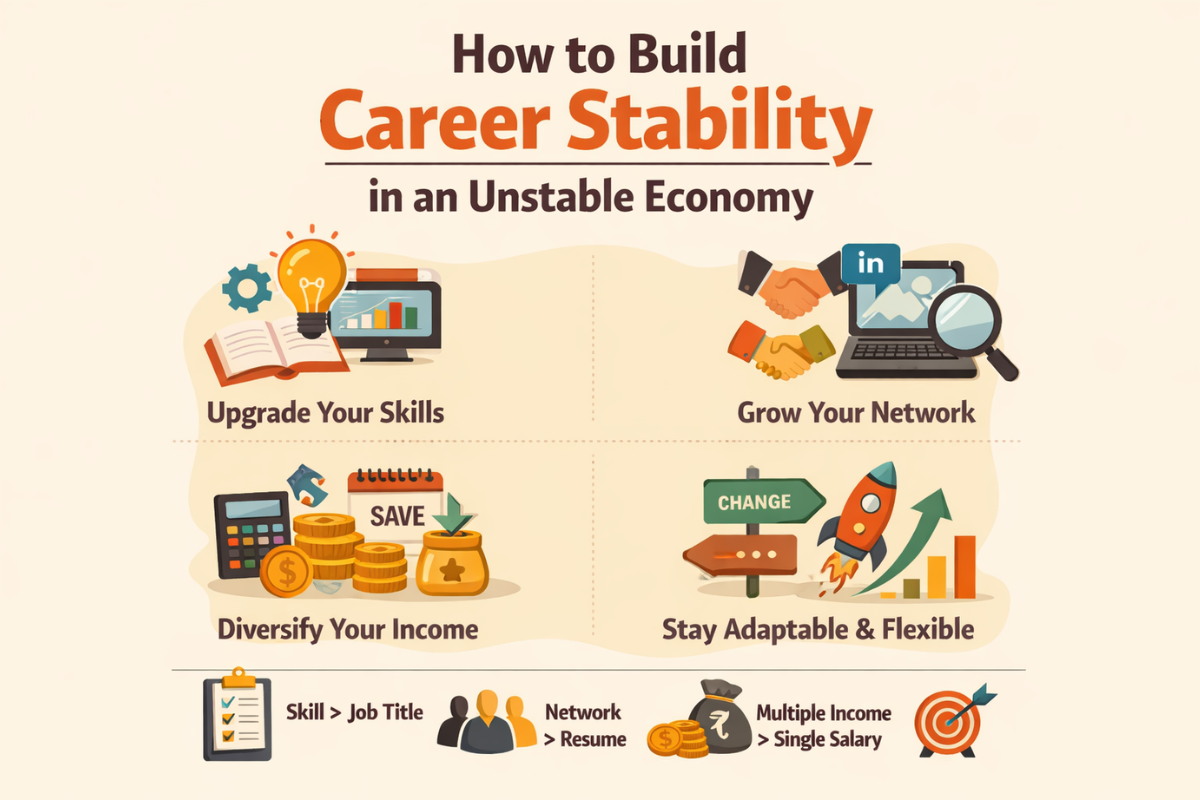
- Focus on building skills, not just chasing job titles
- Do not depend only on compliance work, aim for advisory roles
- Keep learning with a clear purpose
- Build strong relationships and network actively
- Try to create multiple income streams over time
- Maintain financial discipline and savings
- Stay adaptable and open to change
As a CA student or professional, you already have a strong foundation. If you build on it with the right approach, you can create a stable and successful career even in an uncertain economy.
The goal is simple. Make yourself so valuable that opportunities keep coming to you, regardless of the market conditions.
Calling all CA dreamers!
🔴 Are you tired of searching for the perfect articelship or job?
Well, fear no more! With 15,000+ students and professionals already on board, you don't want to be left behind. Be a part of the biggest community around! Join the most reliable and fastest-growing community out there! ❤️
And guess what? It’s FREE 🤑
✅ Join our WhatsApp Group (Click Here) and Telegram Channel (Click Here) today for instant updates.