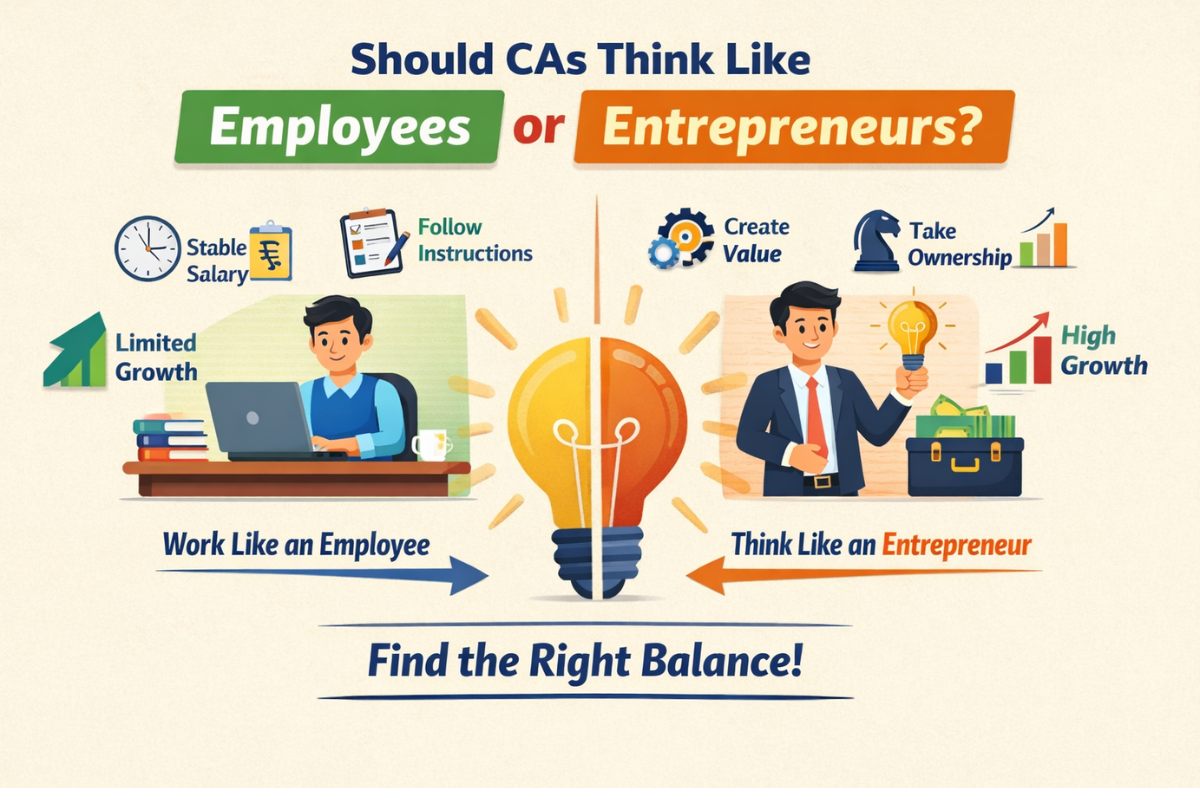
Choosing the right mindset is one of the most important decisions in a Chartered Accountant’s career. Many CA aspirants and newly qualified professionals often feel confused about whether they should think like employees or entrepreneurs. This confusion is natural because the CA profession offers both paths.
The truth is simple but powerful. A CA should not restrict themselves to only one way of thinking. Instead, the goal should be to combine both mindsets at the right time.
This article explains what each mindset means, when to adopt it, and how you can use both to build a strong and successful CA career.
What Does It Mean to Think Like an Employee?
Thinking like an employee means focusing on your assigned role and responsibilities. You work within a system, follow instructions, and aim to perform your tasks efficiently.
Most CAs begin their careers with this mindset, especially during articleship and early job roles.
Key Traits of an Employee Mindset
- You focus on completing tasks given by your seniors. This helps you build discipline and technical accuracy in your work.
- You look for stability in terms of salary, work hours, and job security. This is important when you are starting your career.
- You prefer clear instructions and defined roles. This reduces confusion and helps you learn faster.
- You measure growth through promotions, increments, and designations.
This mindset is not wrong. In fact, it is necessary in the early stages of your career.
Why Is the Employee Mindset Important for CAs?
Before thinking about entrepreneurship, you need a strong foundation. The employee mindset helps you build that base.
Learning Through Structure
When you work under seniors, you understand how real businesses operate. You learn how audits are conducted, how clients behave, and how deadlines are managed.
Exposure to Practical Work
Textbook knowledge is very different from real-life practice. Working as an employee gives you exposure to actual cases, errors, and problem-solving situations.
Financial Stability
In the initial years, earning a stable income is important. It allows you to support yourself and reduces financial pressure.
Skill Development
You develop essential skills such as communication, time management, documentation, and compliance handling. These skills are critical for long-term success.
However, this mindset alone is not enough.
What Are the Limitations of Thinking Only Like an Employee?
If you continue thinking like an employee throughout your career, it can limit your growth.
Limited Income Growth
Your income will largely depend on your salary structure. Even with increments, there is a ceiling.
Lack of Ownership
You may start doing only what is asked of you. This reduces your ability to think independently and take initiative.
Replaceability
If your work is only task-based, someone else can easily replace you. This affects your long-term value in the market.
Slow Career Progression
You may take longer to move into leadership roles because you are not thinking beyond your role.
This is where entrepreneurial thinking becomes important.
What Does It Mean to Think Like an Entrepreneur?
Thinking like an entrepreneur means looking at work from a value and growth perspective. Instead of only doing tasks, you focus on solving problems and creating impact.
You do not necessarily need to start your own firm to think like an entrepreneur. It is a mindset, not just a career choice.
Key Traits of an Entrepreneurial Mindset
- You focus on how value is created for clients or the organisation. This helps you move beyond routine work.
- You identify problems and think of solutions proactively. This makes you more useful and visible.
- You think about revenue, efficiency, and long-term growth. This aligns your thinking with business goals.
- You take ownership of your work and decisions. This builds trust and credibility.
Why Should CAs Develop an Entrepreneurial Mindset?
The CA profession is closely linked to business and finance. This makes entrepreneurial thinking very valuable.
Better Understanding of Business
When you think like an entrepreneur, you start analysing how businesses make money, manage costs, and handle risks. This improves your decision-making ability.
Higher Career Growth
Employers value professionals who think beyond their role. This can help you move into strategic positions like finance manager or CFO.
Opportunity Creation
Instead of waiting for opportunities, you start creating them. This can lead to consulting roles, independent practice, or even starting your own venture.
Strong Professional Identity
You are no longer just completing tasks. You become a problem-solver and advisor, which increases your professional value.
Should CAs Think Like Employees or Entrepreneurs?
The answer is not either or. The right approach is a combination of both.
Start Like an Employee
In the beginning, your focus should be on learning.
- Understand basic concepts and practical applications clearly. This builds your confidence.
- Observe how seniors handle clients and manage work. This gives you real insights.
- Focus on accuracy and discipline. These are non-negotiable in the CA profession.
Gradually Think Like an Entrepreneur
As you gain experience, you should start changing your perspective.
- Try to understand the bigger picture behind your work. Ask why a task is being done.
- Suggest improvements where possible. Even small ideas can create value.
- Take initiative instead of waiting for instructions. This shows leadership potential.
How Can You Develop an Entrepreneurial Mindset as a CA?
Developing this mindset is a gradual process. You can start with simple steps.
Ask Better Questions
Instead of asking what to do, start asking why it is done and how it can be improved. This shifts your thinking from execution to strategy.
Understand the Client’s Business
Do not limit yourself to compliance work. Try to understand the client’s industry, challenges, and goals. This helps you provide better insights.
Focus on Value Addition
Always think about how your work can add value.
- Can your analysis help reduce costs or increase efficiency?
- Can your suggestions improve compliance or reduce risk?
- Can you offer a solution instead of just pointing out a problem?
Build Communication Skills
Entrepreneurial thinking is useful only when you can express your ideas clearly. Work on your communication and presentation skills.
Learn Basic Business Skills
Understanding marketing, pricing, and client management can give you an edge. These are essential if you plan to start your own practice in the future.
What Career Paths Open Up with the Right Mindset?
When you combine both mindsets, you create multiple career options.
Corporate Roles
You can grow into senior roles such as finance manager or CFO. Here, strategic thinking is more important than routine work.
Independent Practice
You can start your own CA firm. This requires patience, networking, and consistent effort, but it offers long-term independence.
Consulting and Advisory
You can move into specialised areas such as risk advisory, tax planning, or business consulting. These roles require problem-solving and analytical thinking.
New-Age Opportunities
You can explore areas like financial content creation, online teaching, or building digital platforms. Many CAs are creating personal brands and generating multiple income streams.
What Is the Biggest Mistake CAs Make?
Many CAs believe that entrepreneurship only means starting a firm. This is not correct.
Entrepreneurial thinking is about mindset, not structure.
- You can be in a job and still think like an entrepreneur.
- You can run a firm but still think like an employee if you only focus on routine work.
The real difference lies in how you approach your work and career.
Practical Example to Understand the Difference
Consider this simple situation.
Employee Thinking
You complete an audit file and submit it. Your focus is on finishing the task correctly.
Entrepreneurial Thinking
You analyse the audit findings and identify areas where the client can improve. You share suggestions that can help the client save costs or avoid future issues.
Both approaches are correct, but the second one creates more value.
Conclusion
So, should CAs think like employees or entrepreneurs?
The answer is both.
In the early stages of your career, thinking like an employee helps you build strong technical skills and gain practical exposure. As you grow, adopting an entrepreneurial mindset helps you create value, take ownership, and achieve higher growth.
The most successful CAs are those who balance both approaches. They learn like employees but think like business owners.
If you want long-term success in your CA career, start focusing not just on what work you do, but how you think about that work. That shift in mindset can completely change your professional journey.
Calling all CA dreamers!
🔴 Are you tired of searching for the perfect articelship or job?
Well, fear no more! With 15,000+ students and professionals already on board, you don't want to be left behind. Be a part of the biggest community around! Join the most reliable and fastest-growing community out there! ❤️
And guess what? It’s FREE 🤑
✅ Join our WhatsApp Group (Click Here) and Telegram Channel (Click Here) today for instant updates.