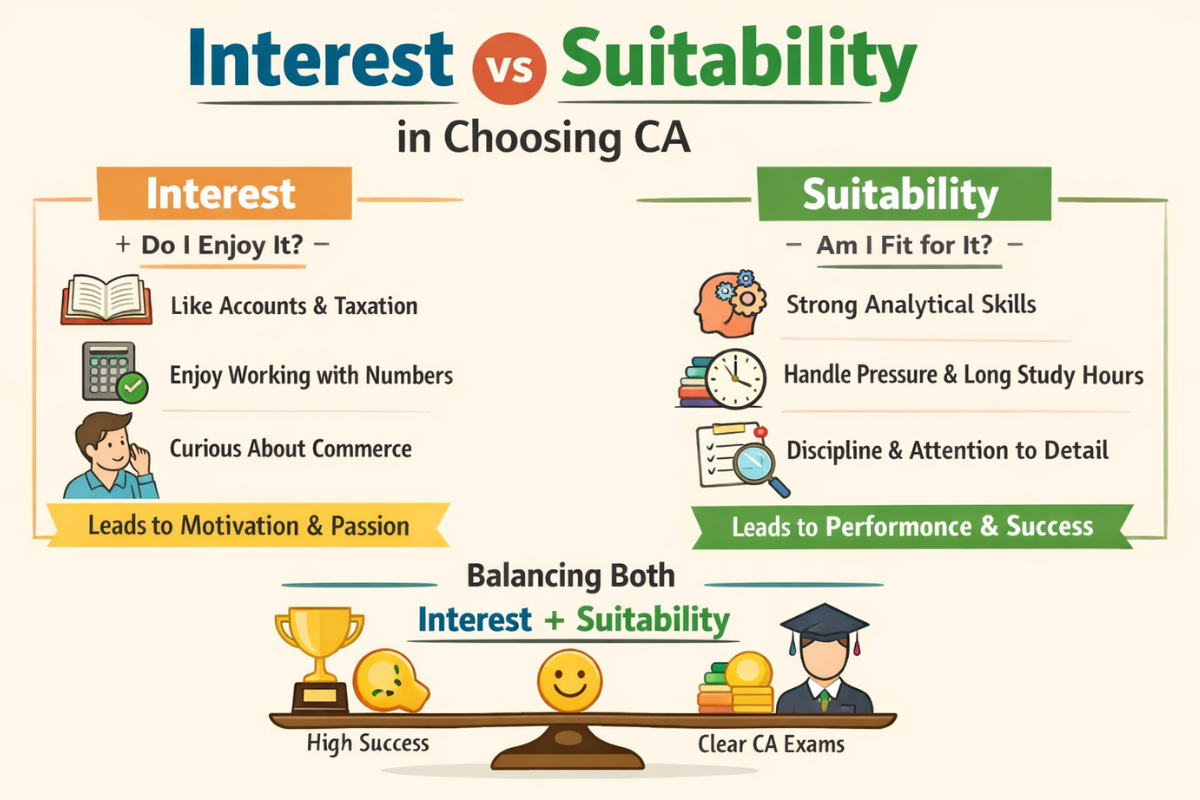
Most students who ask “should I do CA?” are really asking two different questions at the same time — and not realising it.
The first question is: Do I like this? That is a question about interest.
The second question is: Can I actually do this? That is a question about suitability.
Confusing the two — or answering only one — is one of the most common reasons students end up either miserable in a course they are good at but do not enjoy, or struggling through a course they love but cannot seem to pass.
This article explains the difference clearly, shows you what happens when one is missing, and gives you a practical way to assess both honestly before committing to or continuing the CA course.

What Interest Means in the Context of CA
Interest is about what genuinely engages you — what you find yourself curious about and willing to spend time on without being forced.
In the context of CA, interest shows up in specific, observable ways:
- You find accounting problems engaging rather than tedious — you want to understand why the numbers work the way they do, not just get through them
- Subjects like taxation and audit feel relevant and interesting to you, not just requirements to get through
- You can sustain focus on commerce topics for extended periods without constant external pressure to study
- You are curious about how businesses work financially — how profits are calculated, how taxes apply, how audits catch errors
Interest matters in CA for a specific reason: the course is long. You will spend 5 to 7 years preparing, giving exams, and doing articleship. During this time there will be multiple phases where results are discouraging, peers seem ahead, and motivation is low. Interest is what keeps you going through those phases — not willpower, not family pressure, but genuine curiosity about the field. Read our article on how to stay motivated during long CA preparation months to understand how interest connects to sustained effort.
What Suitability Means in the Context of CA
Suitability is about whether your skills, mindset, and working style match what CA actually demands — both during the course and in the profession itself.
The CA course and profession require a specific combination of traits:
| Trait | Why CA demands it | How to know if you have it |
|---|---|---|
| Analytical ability | CA exams test application, not just memory — you must think through problems, not just recall facts | You can work through unfamiliar accounting or legal scenarios by applying principles, not just looking for a formula |
| Discipline and consistency | The course requires sustained daily effort over multiple years — motivation alone will not carry you through | You can maintain a study routine even when you do not feel like it, especially during articleship when you are also working |
| Resilience to failure | Multiple attempts are common even for capable students — this is inherent to the course structure | You can process a failed attempt, identify what went wrong, and return to preparation without losing your sense of self |
| Attention to detail | Small errors in calculations or legal provisions cost marks in exams and cause real problems in professional work | You naturally check your work and notice inconsistencies rather than relying on broad approximations |
| Comfort with both numbers and text | CA combines numerical work (accounts, costing, tax computations) with legal and theoretical frameworks (company law, audit standards) | You can engage with both types of content — not just one or the other |
For a deeper self-assessment of whether you have the traits CA demands, read our guide: how to evaluate your own fit for the CA profession honestly.
The Difference Between Interest and Suitability — Why Both Matter
| Dimension | Interest | Suitability |
|---|---|---|
| What it is | What you enjoy doing | What you are capable of doing consistently |
| What it drives | Motivation and long-term satisfaction | Performance and actual exam success |
| What happens without it | You may be technically capable but feel disconnected and unfulfilled | You may genuinely want it but struggle to pass despite sustained effort |
| Can it be developed? | Partially — exposure can deepen interest, but you cannot force it to appear | Yes — skills and discipline can be built with deliberate effort over time |
| Key question it answers | “Do I want to be a CA?” | “Can I become and remain a CA?” |
The most important insight from this table: both matter, but they work differently. Suitability can be developed more deliberately than interest. You can build discipline, improve your analytical skills, and get better at managing exam pressure through practice and strategy. But if genuine interest is absent — if you do not find the work of accounting, taxation, and audit engaging in any meaningful way — that is much harder to manufacture.
What Happens When One Is Missing
Case 1 — Interest Without Suitability
You genuinely like accounts and want to become a CA. But you struggle with consistent study, find complex conceptual application difficult, or lose focus during long preparation cycles.
What tends to happen:
- You attempt exams with genuine motivation but marks do not reflect the effort
- Each failed attempt erodes confidence because you cannot understand why, if you like it so much, you keep not passing
- The gap between enthusiasm and results creates frustration that compounds over time
What this situation actually calls for: not giving up, but being honest about which specific suitability gaps are the problem. Is it discipline? Analytical application? Time management under exam pressure? Each has a different fix — but the fix requires honest diagnosis, not just more hours studying.
Case 2 — Suitability Without Interest
You are academically capable, disciplined, and can handle the exam structure. But you are pursuing CA because of family expectations, social pressure, or the income and prestige associated with the qualification — not because the actual work engages you.
What tends to happen:
- You may clear exams — possibly even efficiently — but feel increasingly disconnected from what you are studying
- Articleship feels like a grind rather than genuine learning because you do not find the underlying work meaningful
- After qualifying, you may find yourself in a career that looks successful from the outside but feels hollow from the inside
This is a less discussed but very real outcome. Many qualified CAs who feel dissatisfied with their profession trace that dissatisfaction back to a suitability-without-interest decision at the start. Read our deep self-assessment guide: Is the CA profession truly right for you?
Case 3 — Interest and Suitability Together
You find accounting, taxation, and financial analysis genuinely engaging, and you have — or are actively building — the discipline, analytical ability, and resilience that the course demands.
This is not a guarantee of first-attempt success. But it is the combination that predicts sustained progress over the full CA journey and, importantly, satisfaction in the profession after qualifying.
How to Honestly Assess Your Own Interest and Suitability
Step 1 — Look at your academic track record honestly
Not at your absolute marks, but at the pattern. Do you understand accounting and related concepts when you study them, or does the conceptual logic consistently escape you? Are you better at practical application or at rote recall? CA exams test the former far more than the latter — if you can apply, that is a suitability signal. If you struggle to apply despite understanding the theory, that is a gap worth examining.
Step 2 — Observe your study behaviour, not your intentions
What you actually do — not what you plan to do — is more revealing than any self-assessment questionnaire. Do you study regularly without external pressure? Do you find yourself going deeper into commerce topics out of curiosity, or do you always do the minimum required? Your observable habits reveal both interest and the foundational discipline that suitability requires.
Step 3 — Get real exposure before committing fully
If you are considering CA but have not yet started, the most practical assessment is direct exposure:
- Solve CA Foundation level questions and notice how you feel — engaged or bored?
- Read a business newspaper for a week and track whether you are drawn to the finance and taxation stories
- Watch 2 to 3 lectures on accounts or taxation and assess whether the subject pulls your attention or pushes it away
This kind of exposure is more revealing than any personality quiz. Your reaction to the actual content is your clearest signal. Read our guide on what to do right after 12th if you want to become a CA for how to structure this exploration phase.
Step 4 — Be honest about why you are considering CA
This is the hardest step. Common reasons students choose CA that are worth examining:
| Reason for choosing CA | What it signals |
|---|---|
| I find accounting and finance genuinely interesting | Interest signal — positive |
| I am good at studies and want a challenging qualification | Suitability signal — positive, but check if interest follows |
| Everyone around me is doing it | Neither interest nor suitability — social conformity. Examine further |
| It has high income and respect | Outcome motivation — valid, but not sufficient on its own for a 5 to 7 year journey |
| My family expects it | External pressure — the hardest to sustain across years of difficult preparation |
Can You Build Suitability If You Have Interest?
Yes — significantly. Suitability is more developable than most students realise. Discipline can be built through habit formation. Analytical skills improve with deliberate practice. Exam resilience develops through exposure to failure and honest analysis of what went wrong.
Read our guide on top skills every CA student should build beyond the syllabus — many of the skills that underpin CA suitability can be deliberately developed during articleship and preparation.
What is harder to develop is interest. You can expose yourself to the field more deeply, which sometimes deepens existing interest. But if genuine curiosity about accounting, taxation, and financial analysis is absent after honest exposure, that is harder to manufacture through willpower.
What If You Are Unsure?
Uncertainty about interest and suitability at the start of the CA journey is completely normal. The course is long and you cannot fully know how you will respond to it until you are in it.
The most practical approach for someone genuinely unsure:
- Start with the Foundation level — it is the lowest commitment entry point and gives you real exposure to the course’s nature
- Pay attention to what you notice during your first few months — do the subjects engage you? Do you find the work meaningful or just necessary?
- Use articleship as a continuing assessment — the practical work of a CA, done daily, tells you more about fit than any examination
- If you are comparing CA with alternatives, read our guide: CA vs CS vs CMA — which course opens more doors
And if you are already in the CA journey and questioning whether to continue, read our detailed framework: when should you exit the CA course — which separates the genuine signals from the psychological noise that makes this decision so difficult.
FAQs
What if I have interest in CA but I am not confident about my suitability?
This is the most common and most addressable situation. Interest is the harder of the two to develop, so having it is a meaningful starting point. The suitability gaps — discipline, analytical application, exam resilience — can be worked on deliberately. The key is honest diagnosis of which specific gaps exist rather than a general feeling of not being suitable. A structured study plan, the right coaching, and deliberate practice on weak areas address most suitability gaps over time. Read our CA profession fit self-assessment guide to identify your specific gaps.
Can I develop interest in CA if I am not naturally drawn to it?
To a degree. Deeper exposure to the practical work of a CA — through articleship, talking to qualified CAs, or working through real problems — sometimes deepens interest that was initially mild. However, there is a meaningful difference between mild interest that grows with exposure and a genuine absence of curiosity about the field. If you have given the course real exposure and still find the subject matter consistently unappealing, that is a signal worth taking seriously rather than trying to override with motivation.
How do I know if my suitability is a problem that can be fixed or a fundamental mismatch?
The clearest indicator is whether specific, concrete changes to your approach produce improvement. If changing your study method, revision strategy, or coaching input leads to measurable progress — even slowly — that is a fixable suitability problem. If you have genuinely tried multiple different approaches over several attempts with no movement in marks or understanding, that is a different and harder conversation. Read our guide: taking a practical call after failing multiple CA attempts.
Is CA the right choice if I am interested in finance but not specifically in accounting and taxation?
Finance is a broad field and CA is one of several paths into it. If your interest is specifically in investment management, equity research, or financial analysis — rather than accounting, audit, and taxation — CA may not be the most direct route. The CFA is more directly aligned with investment management. An MBA in finance at a good college is more directly aligned with general management and consulting finance roles. CA is the strongest route for careers that specifically involve accounting, tax advisory, audit, compliance, and corporate controllership. Read our guide: CA vs CS vs CMA and our post-CA options guide: ACCA, CPA or MBA after CA for a fuller picture of the career landscape.
Calling all CA dreamers!
🔴 Are you tired of searching for the perfect articelship or job?
Well, fear no more! With 15,000+ students and professionals already on board, you don't want to be left behind. Be a part of the biggest community around! Join the most reliable and fastest-growing community out there! ❤️
And guess what? It’s FREE 🤑
✅ Join our WhatsApp Group (Click Here) and Telegram Channel (Click Here) today for instant updates.