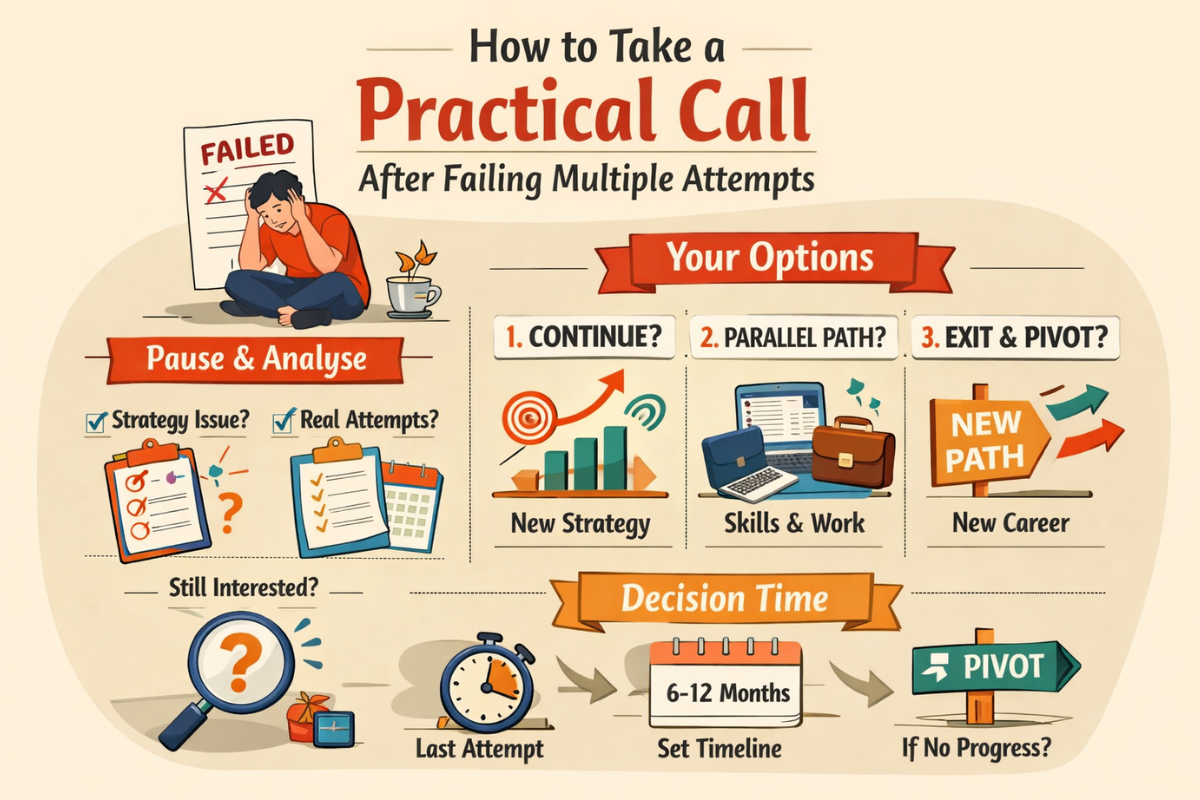
After a certain number of failed attempts, the question stops being “how do I pass?” and becomes something harder: “what do I actually do now?”
This is one of the most difficult moments in the CA journey — not because the answer is complicated, but because everything around you makes thinking clearly very hard. You are emotionally exhausted. You have invested years. People around you have opinions. And you are not sure which voice to listen to.
This guide gives you a structured, honest framework for making this decision — not based on motivation or pressure, but based on a clear-eyed assessment of your actual situation.
Why This Decision Is So Hard to Make
Before working through the framework, it helps to name the forces that make this decision feel heavier than it rationally is:
| Psychological Force | What it says | Why it distorts your decision |
|---|---|---|
| Sunk cost fallacy | “I have invested 4 years — I cannot leave now” | Past investment is gone regardless of what you decide. Only the next 2 to 3 years are relevant to your choice |
| Social pressure | “What will people think if I stop?” | Others’ opinions reflect their comfort, not your career reality |
| Fear of regret | “What if I quit and then wish I hadn’t?” | Continuing without clarity also creates regret — just later |
| Emotional exhaustion | “I am too tired to think clearly” | Decisions made in exhaustion are usually reactive, not strategic |
Recognising these forces does not make the decision easier, but it helps you separate the real signals from the noise. Your decision should come from an honest assessment of your situation — not from any of the above.

Step 1 — Do an Honest Self-Audit Before Deciding Anything
The most common mistake students make is jumping to a decision — continue or quit — without first understanding why they have been failing. The answer to that question changes everything.
Question 1: Was it a strategy problem or an effort problem?
| Signs it was a strategy problem | Signs it was an effort problem |
|---|---|
| You studied but did not revise enough times | You consistently studied fewer hours than required |
| You covered the syllabus but did not solve mock papers under exam conditions | You skipped large portions of the syllabus repeatedly |
| You understood concepts but could not apply them under time pressure | You relied on last-minute preparation most attempts |
| You studied hard close to the exam but lost momentum in between | You were genuinely inconsistent across the preparation cycle |
If it was a strategy problem, changing the approach — not the goal — may be what is needed. If it was a genuine effort problem driven by circumstances, understanding those circumstances matters before deciding. Read our guide on building a CA study plan that actually works before concluding that the course is not for you.
Question 2: Have you given genuine attempts?
Not every registered attempt is a genuine attempt. A genuine attempt means:
- Full syllabus covered at least once before the exam
- Multiple revision cycles, not just one read-through
- Mock papers solved under timed exam conditions
- Mistakes analysed and weak areas specifically addressed
If even two of these four were consistently missing, you have not yet tested your actual potential. That is a different situation from having genuinely attempted the exam multiple times with full preparation.
Question 3: Is there improvement, however small?
Look at your actual marks across attempts — not how the attempts felt emotionally, but the numbers. A student moving from 38% to 43% to 47% across three attempts is on a trajectory that may eventually clear. A student who has been at 35 to 37% across four attempts with the same preparation approach is not.
If you are genuinely improving, even slowly, that is a meaningful signal. If marks are flat or declining despite sustained effort, something more fundamental needs to change. Read our guide on how many attempts are too many in CA for a detailed look at how to interpret your attempt history.
Question 4: Do you still have genuine interest in what CAs do?
This is the most important question and the hardest to answer honestly. There is a meaningful difference between:
- Temporary exhaustion and demotivation — which is normal and recoverable
- Genuine, sustained disconnection from the actual work of a CA — which is a different signal
Ask yourself specifically: if you cleared tomorrow, would you actually be excited about the career ahead — the taxation work, the audit practice, the financial analysis, the advisory roles? If the answer is honestly no, that matters. Read our self-assessment guide: Is the CA profession truly right for you?
Step 2 — Choose One of Three Paths
Once you have done the self-audit honestly, the decision space becomes clearer. There are only three practical paths, and each is valid if chosen with clear reasoning.
Path 1 — Continue, But With a Fundamentally Different Approach
This path makes sense when your self-audit shows that the issue is strategy or approach — not interest or capability.
This path is right if:
- Your marks are improving across attempts, even slowly
- You can identify specific, concrete reasons why you have been failing — and those reasons are fixable
- You still have genuine interest in the CA profession and the work it involves
- You have not yet used a structured, test-based approach — only reading-focused preparation
What must change if you continue:
- Shift to a test-first approach — solve papers from day one of preparation, not only in the last month
- Prioritise revision over new content — multiple revision cycles matter more than covering material once thoroughly
- Address weak subjects specifically — not by spending more time generally, but by diagnosing exactly which question types are costing you marks in those subjects
- Set a defined timeline — continuing without a deadline leads to indefinite drift. Give yourself a specific next attempt with a clear evaluation point after it
Continuing is only a good path when it is backed by a concrete strategy that is different from what you have done before. Read our guide on why some students crack CA and others don’t to understand what the successful approach actually looks like.
Path 2 — Take a Parallel Path
This is often the most practical and underused option. Rather than choosing between CA and something else, you continue your CA preparation while simultaneously building skills, gaining work experience, or exploring adjacent credentials.
What a parallel path looks like in practice:
- Continuing CA preparation while working part-time or doing internships in finance or accounting roles
- Building technical skills alongside preparation — Excel, financial modelling, Tally, SAP basics, or data analysis
- Taking a certificate programme in an adjacent field — CFA Level 1, ACCA papers, or a finance certification — that builds your profile regardless of CA outcome
- Finding the right articleship that teaches you real, marketable skills rather than just ticking the ICAI compliance box
Why this path works: When your entire identity is tied to one exam, each failure feels existential. A parallel path gives you emotional stability because you are making progress in other dimensions even when CA results disappoint. It also means you are not starting from zero if CA ultimately does not work out. Read our guide on CA articleship transfer rules if your current articleship is not providing real learning — switching firms may be the most impactful parallel step you can take.
Path 3 — Exit with Clarity and a Plan
This path is valid and is not failure. It is the right choice when the self-audit reveals that continuing is genuinely not the best use of the next 2 to 3 years of your career.
Exit makes sense when:
- Multiple genuine attempts have shown no meaningful improvement in marks or understanding
- Interest in the CA profession itself — not just the credential — is genuinely absent
- Mental health has been consistently and significantly impacted over an extended period
- Personal circumstances have changed materially and continued CA preparation is not practical
What to do if you exit:
- Identify your transferable strengths from your articleship and CA preparation — financial statement analysis, taxation knowledge, audit exposure, and analytical skills all have value in the job market even without the final qualification
- Research adjacent career paths specifically — corporate finance roles, banking, financial analysis, and fintech all value CA background even without full qualification
- Do not exit without a clear next step — a vague desire to leave is not a plan. Exit with a specific alternative direction
For a detailed framework on making the exit decision, read our guide: When should you exit the CA course?
Step 3 — Make the Decision With a Timeline and a Review Point
Whichever path you choose, the decision becomes more effective when it is time-bound rather than open-ended.
| Path chosen | Recommended timeline | Review point |
|---|---|---|
| Continue with new strategy | 6 to 12 months — one defined exam attempt | After results: has the new approach produced improvement? If not, revisit Path 2 or 3 |
| Parallel path | 6 months of parallel activity alongside preparation | After 6 months: are you progressing in both dimensions? Is CA still the right primary goal? |
| Exit and pivot | Define your alternative within 30 to 60 days of deciding to exit | After 3 months in the new direction: are you moving forward? |
A decision without a timeline leads to indefinite drift — which is the worst outcome of all. Whatever you decide, build a review point into the plan from the start.
Mistakes to Avoid While Making This Decision
- Making the decision while emotionally exhausted. Take a short break — even 1 to 2 weeks — before deciding. Read our guide on staying positive after failing a CA attempt for practical ways to reset before making any call
- Repeating the exact same approach and expecting different results. If you choose to continue, something concrete must change — not just your effort level but your actual preparation method
- Making the decision based on what others are doing. Your CA journey is not comparable to anyone else’s. Read why students stay stuck in CA even when they want to quit to understand how social forces distort this decision
- Treating exit as shameful. Leaving CA with a clear plan and a well-reasoned alternative is a better outcome than staying in indefinite confusion for years
- Waiting for motivation before deciding. Motivation is temporary. This decision needs logic and planning, not an emotional state that may or may not arrive
What Your Articleship Situation Tells You
One underused signal in this decision is the quality of your articleship experience. Students who are in good articleship placements — learning real skills, getting meaningful exposure — tend to have a different relationship with the CA journey than those who are not.
If your articleship is not providing genuine learning, changing it may be one of the most impactful things you can do — independent of whether you continue the exams or not. A better articleship improves your CA Final preparation and significantly strengthens your CV regardless of your ultimate decision about the qualification. Browse CA Firm Articleship openings and Industrial Training openings on BuddingCA if your current placement is not serving you well.
FAQs
How many CA attempts is it reasonable to give before seriously reconsidering?
There is no universal number — ICAI does not define one, and neither should you. What matters more than the count is whether you are improving across attempts and whether each attempt was genuinely well-prepared. Students who failed 5 or 6 times before qualifying are not uncommon among practising CAs. The signal to watch is stagnation — same marks, same approach, no change — not the number itself. Read our detailed analysis: how many attempts are too many in CA exams.
Is the parallel path approach actually practical during CA articleship?
Yes — more than most students realise. Articleship itself is a form of parallel activity. The question is whether your articleship is providing genuine skill-building alongside exam preparation. Students who choose their articleship deliberately — for real learning rather than just ICAI compliance — are already on an effective parallel path. If your articleship is not teaching you real skills, a transfer may be the most impactful move you can make right now.
What can I do professionally if I exit CA mid-journey?
The articleship experience and CA preparation build real, marketable skills — financial statement analysis, taxation knowledge, audit exposure, and accounting competency all have genuine value in corporate finance, banking, financial analysis, and fintech roles. Many professionals who left CA mid-journey have built strong careers in these fields. The key is not to exit without direction — you need a specific alternative, not just a desire to leave. Read our guide: when should you exit the CA course.
How do I tell my family I am reconsidering CA?
The most effective approach is to present a clear alternative — not “I want to stop CA” but “I want to stop CA and here is specifically what I plan to do instead, and here is why it is a better fit for my situation.” A vague desire to leave is hard for families to accept. A concrete plan with specific next steps is significantly easier to discuss. Coming to that conversation with clarity — rather than confusion — changes the dynamic completely.
Calling all CA dreamers!
🔴 Are you tired of searching for the perfect articelship or job?
Well, fear no more! With 15,000+ students and professionals already on board, you don't want to be left behind. Be a part of the biggest community around! Join the most reliable and fastest-growing community out there! ❤️
And guess what? It’s FREE 🤑
✅ Join our WhatsApp Group (Click Here) and Telegram Channel (Click Here) today for instant updates.