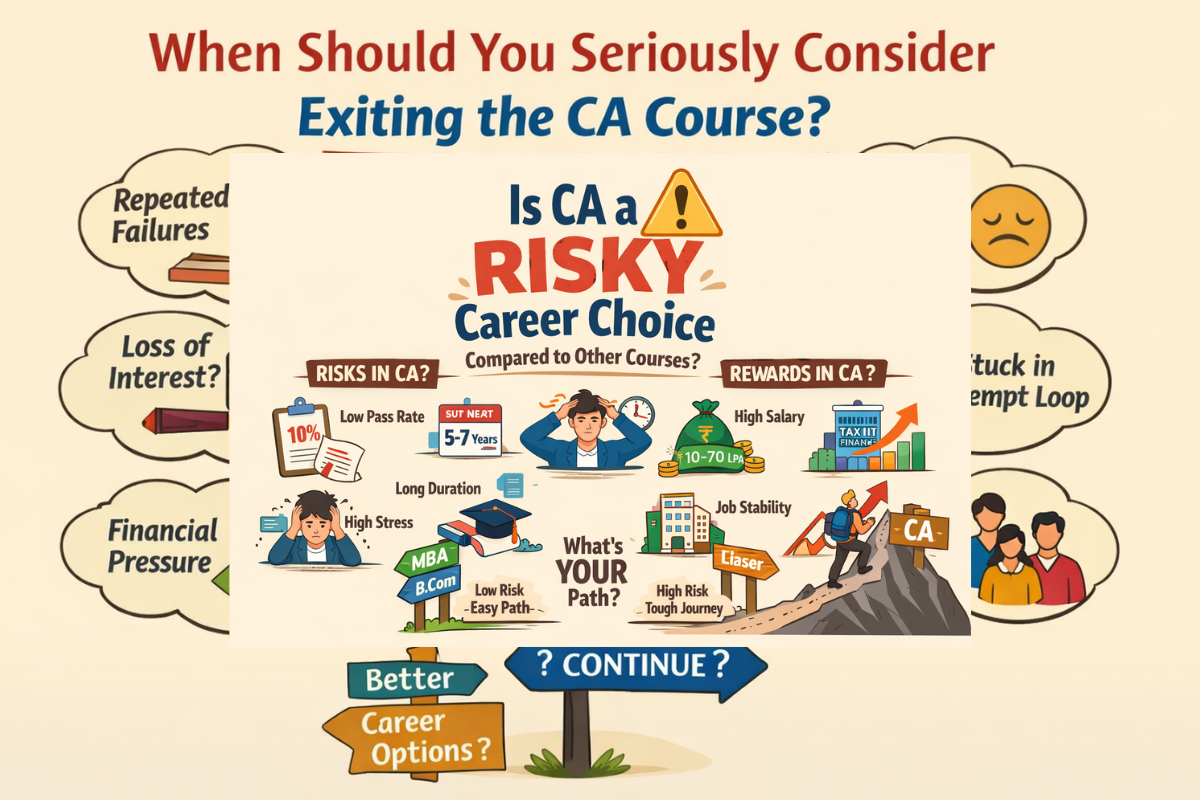
This is one of the most searched and least honestly answered questions in the CA community: when should you actually quit?
Most articles either tell you to never give up — with motivational quotes — or give you a list of vague signs that could apply to anyone on a bad week. Neither is useful when you are sitting with four failed attempts, a growing opportunity cost, and a very real question about what to do next.
This guide gives you an honest, structured framework. Not to push you to quit, and not to force you to continue — but to help you make a decision based on clarity rather than sunk cost, fear, or social pressure.
Why This Decision Feels So Heavy
Before evaluating whether to exit, it helps to understand what makes this decision feel so much heavier than it might rationally deserve to be.
The sunk cost problem. You have invested years of effort and the thought of walking away from that investment feels irrational. But the years already spent are gone regardless of what you decide next. The only relevant question is what the next 2 to 3 years look like in either direction.

Social and family pressure. In India, CA carries significant prestige. Leaving it can feel like a public failure even when it is privately the right call. Many students continue the course not because they believe in continuing, but because they fear what others will think if they stop.
The absence of a clear alternative. If you do not know what you would do instead, staying in CA — even without progress — feels safer than leaving. Read our article on why students stay stuck in CA even when they want to quit for a deeper look at this dynamic.
Recognising these forces does not make the decision easier, but it makes it clearer. You can only make a good decision about CA when you separate the real signals from the psychological noise.
Five Clear Signals That Warrant a Serious Reassessment
These are not reasons to quit automatically. They are reasons to stop and evaluate honestly rather than continuing on autopilot.
Signal 1 — No Improvement Across Multiple Attempts
Failing CA exams is normal — many successful qualified CAs failed multiple times. What is not normal, and what warrants serious reflection, is failing without any meaningful improvement in your marks or understanding.
The difference matters:
| Situation | What it suggests |
|---|---|
| Failing but marks are improving steadily | The strategy is working — continue with adjustments |
| Failing with marks flat or declining across 3 to 5 attempts | Something fundamental is not working — strategy, guidance, or interest needs examination |
| Failing the same subjects repeatedly with the same preparation approach | The approach is the problem, not your capability |
If you are in the second or third category, the first question is not “should I quit?” but “what specifically is not working?” Before treating this as a reason to exit, read our guide on how many attempts are too many in CA and honestly assess whether the issue is strategy, guidance, or something deeper.
Signal 2 — Complete Loss of Interest in the Profession Itself
There is an important difference between temporary demotivation — which every CA student experiences — and a genuine, sustained disconnection from the work that CAs do.
Ask yourself this specific question: if you cleared CA Final tomorrow, would you actually feel excited about the career ahead?
If the honest answer is no — not just uncertain or tired, but genuinely no — that is a signal worth taking seriously. A demanding course that takes 5 to 7 years to complete requires internal motivation. If you have no interest in taxation, audit, financial analysis, or advisory work, sustaining that effort becomes increasingly difficult. Read our self-assessment guide: Is the CA profession truly right for you?
Signal 3 — Consistent and Serious Mental Health Impact
The CA journey is demanding and some stress is inherent to it. But there is a meaningful difference between exam pressure — which is normal and manageable — and a sustained deterioration in your mental health that persists outside exam periods.
Warning signs that go beyond normal exam stress:
- Persistent anxiety or low mood that does not lift significantly between exam cycles
- Complete loss of confidence in yourself as a person, not just as a student
- Emotional exhaustion that makes basic daily functioning difficult
- Withdrawal from relationships and activities you previously valued
If you are experiencing these consistently, the right first step is not necessarily to quit — it is to speak to someone, whether a counsellor, mentor, or trusted senior. Read our article on the emotional cost of the CA journey for an honest look at this dimension.
Signal 4 — You Are Stuck in an Attempt Loop With No Movement
An attempt loop is when your entire life cycles between preparation, exam, results, and restart — with no meaningful change in strategy, skills, or outlook between cycles. Years pass, but nothing develops.
This is different from taking multiple attempts while genuinely evolving your approach. The attempt loop is specifically characterised by repetition without reflection. If you cannot clearly describe what you are doing differently in this attempt compared to the last three, that is the loop.
Being in an attempt loop for years without any other professional development — skills, work experience, or alternative education — means the opportunity cost is compounding in a way that is worth honestly evaluating.
Signal 5 — Your Personal Circumstances Have Changed Materially
Sometimes the question is not about your commitment to CA but about the practical realities of your life.
Family financial responsibilities, health issues in the family, or a life stage where income stability is genuinely necessary are all legitimate factors that can change the CA calculus. A course that made sense at 20 may not make the same sense at 27 with different responsibilities.
This does not mean you must quit — many students continue CA while managing other responsibilities. But it does mean the decision should be made with eyes open to the real opportunity cost, not with optimism that does not account for actual circumstances.
When You Should Absolutely Not Quit Yet
Just as important as knowing when to consider exiting is knowing when the signals are being misread.
| Situation | Why this is not a reason to quit |
|---|---|
| You have failed one or two attempts | This is normal in CA and does not indicate lack of capability — most qualified CAs failed at least once |
| You are feeling temporarily demotivated or burnt out | This is a reason to rest and reset, not to exit — read our guide on staying positive after failing an attempt |
| You have not tried a structured, strategic study approach | Many students fail due to poor planning, not lack of ability — see our CA exam study plan guide |
| You have not sought proper mentorship or coaching guidance | The right guidance can significantly change outcomes — the problem may be the approach, not you |
| You are comparing yourself to peers who cleared faster | CA journeys are not comparable — your timeline is your own, read why some students crack CA in the first attempt to understand what actually separates outcomes |
A Practical Decision Framework
Rather than making an emotionally-driven decision in either direction, use this five-question framework to structure your thinking:
| Question | What a positive answer looks like | What a negative answer suggests |
|---|---|---|
| Am I improving with each attempt, even slightly? | Marks or understanding are moving in the right direction | Flat or declining — strategy needs fundamental change |
| Do I genuinely want to become a CA, or am I forcing myself? | You can picture yourself in CA work and it feels right | The career itself does not appeal — just the credential |
| Is my mental health broadly stable while preparing? | Exam stress is normal but you function well outside it | Persistent low mood or anxiety beyond exam periods |
| Am I building any skills or experience alongside CA? | Articleship is teaching you real skills you can articulate | The course is consuming everything with nothing to show |
| If I leave CA, do I have a clear, considered alternative? | You have thought through realistic next steps | Leaving without a plan — this needs to be addressed first |
If most of your answers are positive, continuing with a changed strategy makes sense. If three or more are negative, a serious reassessment is warranted. Read our article on the ROI of the CA course for a data-backed look at time investment versus career outcomes.
What to Do Before Making Any Decision
If you are seriously considering exiting, do not make a rushed decision. Take these steps first:
Talk to someone who understands the CA journey. Not a family member who will tell you to continue regardless, and not a friend who will tell you to quit because they find it too hard. A mentor, senior CA, or teacher who can assess your specific situation honestly.
Analyse your attempts with genuine honesty. Not “I failed because the paper was hard” — but specifically which subjects, which topics, which types of questions are consistently costing you marks, and what has changed or not changed in how you prepare for those.
Explore alternatives before exiting. Not as a backup that you half-heartedly pursue, but as a genuine investigation. Options like ACCA, CFA, or MBA, or direct roles in finance and accounting, deserve real evaluation before you decide.
Consider a planned break rather than a permanent exit. Sometimes what feels like the need to quit is actually the need to rest and reset. Read our guide on taking a break in the CA journey. A 2 to 3 month structured break with a clear return plan is very different from drifting away indefinitely.
What Happens If You Do Exit?
It is worth being clear about this: leaving CA is not a dead end, and it is not the failure that social pressure makes it feel like.
Many professionals who left CA have built strong careers in corporate finance, banking, consulting, financial analysis, and other fields. The articleship experience — the real skills built there, not just the fact of having done it — carries genuine value in the job market even without the final qualification.
What matters is not whether you leave, but whether you leave with clarity and a plan rather than with confusion and a feeling of defeat. The top career paths in finance and non-traditional CA career options are worth reading even if you are considering exit — they help you see the landscape clearly.
FAQs
How many CA attempts is too many before considering exit?
ICAI does not define a maximum number of attempts, and there is no universal number that makes exit the right decision. What matters more than the count is whether you are improving across attempts and whether your strategy and approach are genuinely evolving. Students who failed 4 to 5 times before qualifying are common among practising CAs. The signal to watch is stagnation — same marks, same subjects, same approach — not the number itself. Read our detailed guide on how many attempts are too many.
Is quitting CA the same as failing?
No. Leaving CA is a career decision, not a character verdict. The framing of “quitting” as failure is a social construct, not a professional reality. Many people who left CA mid-journey have gone on to build strong careers in finance, banking, consulting, and other fields. What actually matters is whether you make the decision with clarity and a plan, or with confusion and no direction. A well-reasoned exit is a better outcome than years of directionless continuation.
What should I do if my family won’t support my decision to leave CA?
This is one of the most practically difficult aspects of this decision in India. The most effective approach is to present a clear, considered alternative — not just “I want to leave CA” but “I want to leave CA and here is specifically what I plan to do instead, and here is why it is a good fit for me.” A vague desire to leave is hard for families to support. A clear plan for what comes next is significantly easier. Having a mentor or respected senior who can speak to your situation can also help mediate the conversation.
Can I return to CA after taking a break or after leaving for some time?
Yes, subject to ICAI’s registration validity rules. CA Inter and CA Final registrations have validity periods, after which re-registration may be required. The specific rules depend on when you registered and how much time has elapsed. Check ICAI’s current regulations at icai.org or contact your regional ICAI office for the specifics of your situation before making any decisions.
Calling all CA dreamers!
🔴 Are you tired of searching for the perfect articelship or job?
Well, fear no more! With 15,000+ students and professionals already on board, you don't want to be left behind. Be a part of the biggest community around! Join the most reliable and fastest-growing community out there! ❤️
And guess what? It’s FREE 🤑
✅ Join our WhatsApp Group (Click Here) and Telegram Channel (Click Here) today for instant updates.