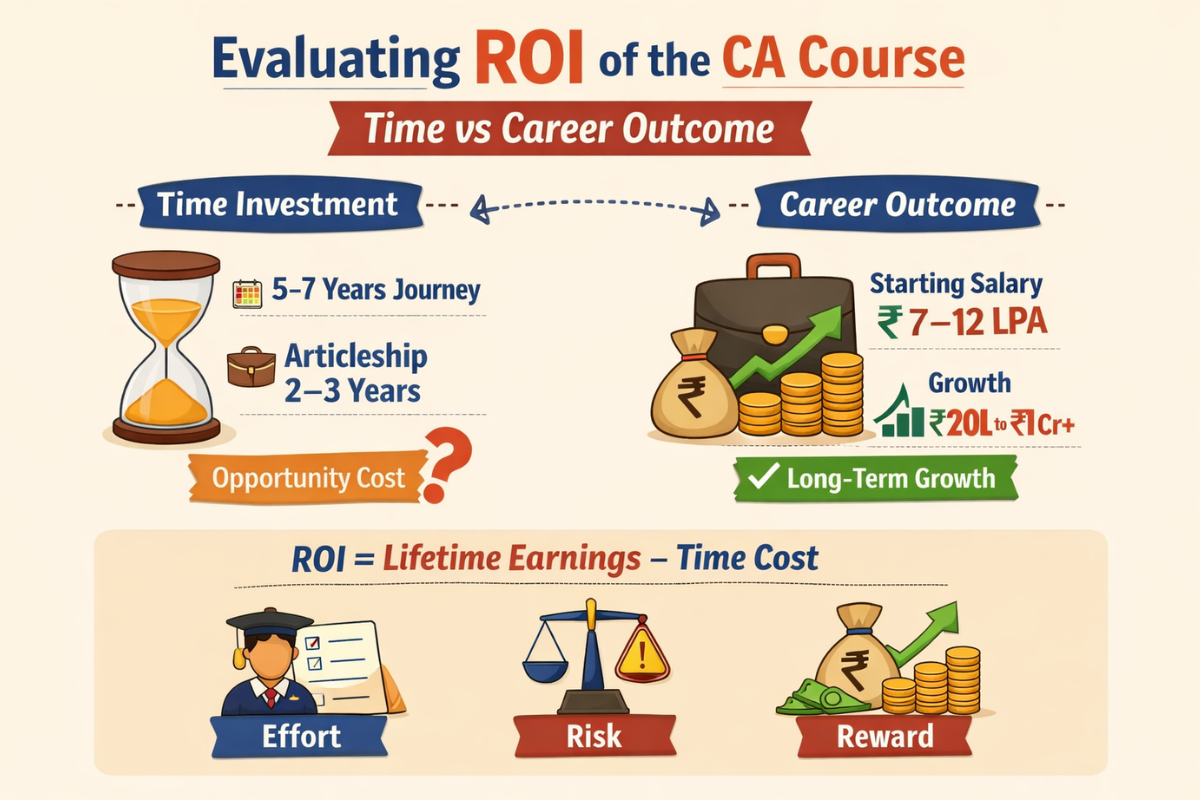
Choosing Chartered Accountancy is one of the most significant career decisions a commerce student can make. The course is long, the exams are hard, and the opportunity cost is real. At some point during the journey — often during the second or third attempt at CA Final — a very honest question emerges:
Is this actually worth it?
This article answers that question practically, with real salary data from ICAI’s campus placements, an honest look at time investment, and a clear framework for thinking about ROI — so you can make a decision based on evidence, not anxiety.
What Does ROI Mean for the CA Course?
Return on Investment in the context of CA is not just about money. It has three components:
| Input | Output |
|---|---|
| Time invested in studying and clearing exams | Starting salary and career trajectory after qualification |
| Effort sustained over multiple years | Professional credibility and long-term earning potential |
| Opportunity cost of delayed income during articleship | Financial independence and career optionality post-qualification |
The most important insight about CA ROI is this: the course itself does not change. What changes dramatically is how you go through it — how many attempts you take, how seriously you treat your articleship, and what skills you build alongside the exams. These variables determine whether your CA journey is high-ROI or low-ROI far more than the qualification itself.

The Real Time Investment in CA
Most students underestimate how long CA actually takes. Understanding this honestly is the starting point for any ROI calculation.
| Scenario | Typical Duration | What it includes |
|---|---|---|
| Best case | 4.5 to 5 years | Foundation, Inter, 3 years articleship, Final — all cleared efficiently |
| Most common | 5 to 7 years | One or two additional attempts at Inter or Final stage |
| Extended | 7 to 10 years | Multiple attempts, breaks, or late starts |
The gap between best case and most common is not a character flaw — it is simply the reality of one of India’s hardest professional examinations. But it matters for ROI because every additional year in the extended timeline is a year of delayed earning, delayed financial independence, and delayed compounding of your career growth.
This is the “hidden cost” of CA that most students do not factor in when they start: the opportunity cost of time, not just the fees paid.
The Financial Investment in CA
One of CA’s genuine advantages over alternatives like an MBA is its low direct cost.
| Cost Type | Approximate Amount | Notes |
|---|---|---|
| ICAI registration and exam fees | Rs 30,000 to Rs 50,000 total | Across all three levels |
| Coaching classes | Rs 1,00,000 to Rs 2,00,000 | Varies significantly by institute and city |
| Study materials and books | Rs 20,000 to Rs 40,000 | ICAI materials plus reference books |
| Total direct cost | Rs 1.5 to Rs 3 lakh | Well below MBA or CFA alternatives |
The indirect cost, however, is significant and often ignored. During your articleship years, your stipend is limited — typically Rs 3,000 to Rs 25,000 per month depending on your firm. Compare this to a peer who started working after graduation at Rs 3 to Rs 5 LPA, and the gap in accumulated earnings over 5 to 7 years is meaningful.
This is not a reason to avoid CA. It is a reason to take the time investment seriously and move through the course as efficiently as possible.
What Career Outcomes Can You Actually Expect After CA?
This is where the data matters most. Let us look at verified numbers rather than aspirational ones.
Fresher Salaries — ICAI Campus Placement Data 2025
ICAI’s 62nd Campus Placement Programme (August to September 2025) provides the most reliable benchmark for what freshly qualified CAs actually earn:
| Metric | Figure | Source |
|---|---|---|
| Highest domestic package | Rs 26.60 LPA | ICAI 62nd Campus Placement — offered by PFC |
| Average package at campus placement | Rs 12.88 LPA | ICAI 62nd Campus Placement |
| Typical range for most freshers | Rs 6 to Rs 14 LPA | ICAI placement data and market sources |
| Big 4 fresher packages | Rs 7 to Rs 10 LPA | Multiple market sources, 2026 |
| Rank holders and first-attempt passes | Rs 13 to Rs 18 LPA | Market data, 2026 |
The honest interpretation of this data: the Rs 12.88 LPA average at campus placement is a reasonable benchmark for a well-prepared fresher with good articleship background. The Rs 6 to Rs 8 LPA figures reflect CAs who qualify later, have weaker articleship exposure, or join smaller employers outside campus placements.
Salary Growth With Experience
| Experience Level | Typical Salary Range |
|---|---|
| Fresher (0 to 2 years) | Rs 6 to Rs 14 LPA |
| Mid-level (3 to 5 years) | Rs 12 to Rs 20 LPA |
| Senior (5 to 10 years) | Rs 20 to Rs 35 LPA |
| Leadership (CFO, Partner track) | Rs 50 LPA to Rs 1 crore and above |
CA is not a qualification that delivers maximum returns at entry level. Its real strength is the compounding of earnings and career optionality over time. A CA who starts at Rs 10 LPA and moves into corporate finance, consulting, or advisory has a genuinely different career trajectory at year 10 compared to most other commerce graduates who started earning earlier.
When Does CA Give the Best ROI?
ROI is highest when these four conditions align:
1. You clear in fewer attempts. First-attempt passouts not only get more interview calls — they also enter the job market faster, which means the compounding of career growth starts earlier. The ICAI campus placement data consistently shows that first-attempt candidates attract higher packages from more prestigious employers.
2. You choose a strong articleship. Articleship is not just a regulatory requirement — it is the primary differentiator at the point of qualification. Students who do meaningful audit, tax, or finance work at reputed firms enter the job market with demonstrably stronger skills than those who treat articleship as something to get through. For guidance on finding the right articleship, browse our CA Firm Articleship openings and Industrial Training openings.
3. You build skills beyond the syllabus. In 2026, clearing CA Final is necessary but not sufficient. Employers consistently report that candidates who combine their CA qualification with Excel proficiency, financial modelling, SAP familiarity, or strong communication skills stand out significantly in interviews and earn better packages. These skills do not take years to build — they take consistent months.
4. You stay consistent. CA rewards sustained effort more than intense bursts. Students who maintain a regular study discipline alongside their articleship — even 2 to 3 focused hours per day — consistently outperform those who study intensively only close to exams.
When Does CA Become Low ROI?
Being honest about this is important. CA becomes a low-ROI choice in specific situations:
| Situation | Why ROI Suffers | What to Do Instead |
|---|---|---|
| Multiple attempts without changing approach | Time increases without proportional improvement in outcome | Honestly diagnose what is not working and change it — coaching style, study method, or time allocation |
| Pursuing CA without genuine interest | Sustained effort is nearly impossible without intrinsic motivation | Explore whether the interest lies in the work CAs do or just the credential |
| Weak articleship treated as box-ticking | Qualification without practical skills reduces employability and starting salary | Seek firms and roles that offer genuine learning, even if the stipend is lower |
| No skill development alongside exams | Degree alone is insufficient in 2026’s job market | Build at least one technical skill — financial modelling, SAP, or data analysis — before your final attempt |
CA vs Other Professional Courses — A Realistic Comparison
| Course | Duration | Direct Cost | Starting Salary Range | Best Suited For |
|---|---|---|---|---|
| CA | 5 to 7 years (typical) | Rs 1.5 to Rs 3 lakh | Rs 6 to Rs 14 LPA | Audit, tax, finance, consulting, CFO track |
| MBA (IIM/top college) | 2 years post-graduation | Rs 20 to Rs 35 lakh | Rs 15 to Rs 30 LPA | Management, consulting, marketing, general management |
| CFA | 3 to 4 years alongside work | Rs 3 to Rs 5 lakh | Rs 8 to Rs 15 LPA | Investment management, equity research, portfolio management |
| MBA (Tier 2 or 3 college) | 2 years | Rs 5 to Rs 15 lakh | Rs 3 to Rs 6 LPA | Limited differentiation in most roles |
The comparison makes CA’s value proposition clear. For the career paths where CA is relevant — accounting, audit, tax, corporate finance, advisory — it is the most cost-effective route available. A top MBA gets you there faster but at 10 to 15 times the financial cost. CFA gives you investment-focused credentials but narrows your career options. CA gives you breadth, depth, and regulatory standing at a fraction of the MBA’s cost — if you move through it efficiently.
Practical Questions to Ask Yourself Before Continuing or Quitting
If you are mid-journey and questioning whether to continue, ask these specifically:
- Am I improving with each attempt? If your marks are consistently moving in the right direction, continue. If you are repeating the same score repeatedly, the strategy needs to change — not necessarily the goal.
- Do I have genuine interest in what CAs do? Not just the credential, but the actual work — financial statements, taxation, audit, advisory. If the answer is no, it is worth exploring whether a different path serves you better.
- Is my articleship adding real skills? If you are not learning anything meaningful at your current firm, a transfer may improve your long-term ROI more than another exam attempt. Read our guide on CA Articleship Transfer Rules to understand your options.
- What does my CA Final timeline realistically look like? Map it out honestly. If you are 2 to 3 years away from qualifying, that is still a viable path. If you are 5 to 6 years away with no clear strategy, a harder conversation with yourself is warranted.
How to Maximise the ROI of Your CA Journey
- Plan attempts realistically. Rushing into an attempt you are not ready for costs you 6 months and the exam fee. One well-prepared attempt beats two rushed ones.
- Choose articleship for learning, not convenience. The firm that is closer to your home but offers less learning will cost you more in the long run. BuddingCA posts daily articleship openings across all cities — browse CA Firm Articleships and Industrial Training openings to find the right match.
- Build at least one technical skill during articleship. Excel, financial modelling, SAP basics, or Power BI. These skills take 2 to 3 months of consistent effort and measurably improve your starting salary.
- Prepare for campus placement from day one of CA Final. ICAI’s campus placement programme runs twice a year. Registration, CV preparation, and interview practice should start well before your result, not after.
- Consider industrial training seriously. If you are in your final year of articleship and eligible, industrial training at the right company can significantly enhance your CV and starting salary. Read our CA Industrial Training guide and the IT vs Articleship comparison to make an informed decision.
Conclusion — Is CA Worth It in 2026?
Based on the data and the framework above, here is an honest answer:
CA is worth it if you move through it with a clear strategy, choose your articleship deliberately, build skills alongside your exams, and clear in a reasonable number of attempts. In that scenario, the combination of a strong qualification, deep practical training, and low financial cost makes CA one of the best career investments available to a commerce student in India.
CA is not worth it — or at least becomes increasingly low-ROI — if years pass without improvement, if the work CAs do genuinely does not interest you, or if articleship becomes purely a compliance exercise rather than a training experience.
The qualification does not determine your ROI. How you go through it does.
FAQs
What is the average salary of a CA fresher in India in 2026?
According to ICAI’s 62nd Campus Placement Programme (August to September 2025), the average salary package at campus placement was Rs 12.88 LPA. The highest domestic package in that drive was Rs 26.60 LPA, offered by PFC. For freshers outside campus placement, the typical range is Rs 6 to Rs 14 LPA depending on employer type, city, articleship background, and attempt count.
How many years does CA actually take to complete?
The ideal timeline is 4.5 to 5 years — covering Foundation, Inter, three years of articleship, and CA Final cleared efficiently. In practice, most students take 5 to 7 years due to one or two additional attempts. Students who take 8 to 10 years face meaningfully lower ROI as the opportunity cost of delayed earning grows significantly.
Does the number of attempts affect CA salary?
Yes, meaningfully at the fresher stage. First-attempt passouts consistently attract more interview calls and higher starting packages, particularly at Big 4 firms and MNCs. However, attempt count becomes less relevant with experience — within 3 to 5 years of qualifying, your actual skills and work quality determine your salary far more than your exam history.
Is CA better than an MBA in terms of ROI?
For careers in audit, tax, corporate finance, and advisory — yes, CA offers better ROI than most MBA programmes. The direct cost is 10 to 15 times lower than a top MBA, and the career outcomes in finance-specific roles are comparable. A top IIM MBA delivers faster ROI and better outcomes in general management, consulting, and non-finance domains. A Tier 2 or Tier 3 MBA rarely delivers better ROI than CA for commerce students. The right answer depends entirely on what kind of work you want to do after qualifying.
Calling all CA dreamers!
🔴 Are you tired of searching for the perfect articelship or job?
Well, fear no more! With 15,000+ students and professionals already on board, you don't want to be left behind. Be a part of the biggest community around! Join the most reliable and fastest-growing community out there! ❤️
And guess what? It’s FREE 🤑
✅ Join our WhatsApp Group (Click Here) and Telegram Channel (Click Here) today for instant updates.