Every commerce student hears two contradictory things about CA. One set of people says it is one of the best careers in India — high income, respect, and job security. Another set says it is too difficult, too uncertain, and not worth the years it takes.
Both are partially right. And both miss the most important point: the risk in CA is not about the career at the end — it is about the journey to get there.
This article gives you an honest, data-backed answer to whether CA is a risky career choice, so you can make a decision based on clarity rather than opinion.
What Kind of Risk Does CA Actually Involve?
Before evaluating whether CA is risky, it is useful to separate two very different types of risk:
| Type of Risk | What it means for CA | How real is it? |
|---|---|---|
| Journey risk | The uncertainty of whether you will complete the course within a reasonable time | Very real — pass rates are low and timelines vary significantly |
| Career risk | The uncertainty of job availability and income after qualifying | Low — demand for qualified CAs is consistent and growing |
Most students who say CA is risky are talking about journey risk. Most people who say CA is safe are talking about career risk. Both are right about their respective points. Understanding this distinction is the starting point for any honest evaluation of CA as a choice.

The Real Risks in the CA Journey
Low Pass Rates — The Most Significant Risk
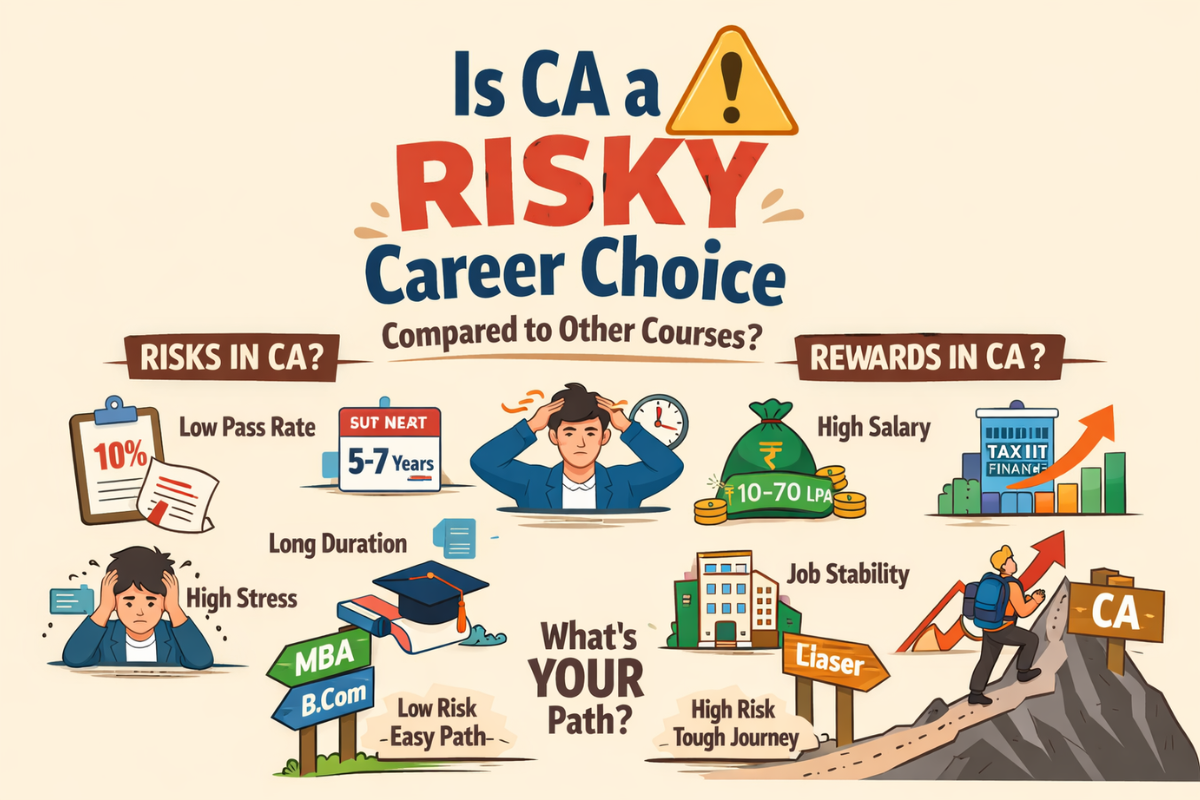
CA exams are among the hardest professional examinations in India. Pass rates at the Intermediate and Final levels are consistently low, meaning most students take more than one attempt to clear each stage. This creates genuine uncertainty in your timeline and progress — and it is the primary reason CA feels risky to many students.
Unlike a college degree where completion is almost guaranteed if you attend classes and put in effort, CA does not offer that certainty. Students with strong academic backgrounds and consistent preparation still fail. This is a fact, and any honest assessment of CA risk must acknowledge it.
Time Investment Risk
The ideal CA timeline is 4.5 to 5 years. The realistic timeline for most students is 5 to 7 years. Some students take longer. Every additional year in the timeline is a year of delayed earning, delayed financial independence, and delayed career compounding.
During this period, you are doing articleship at stipends that are significantly lower than what your peers who took other routes may be earning. This opportunity cost is real and should be factored in honestly when evaluating CA as a choice. For a detailed analysis of this time-versus-outcome question, read our article on the ROI of the CA course.
Psychological Pressure
The CA journey involves sustained effort over multiple years, repeated examination stress, and the social pressure of watching peers advance while you are still studying. This psychological toll is frequently underestimated by students starting the course.
The emotional cost of repeated attempts, comparison with peers, and family expectations is real and significant. If you are not mentally prepared for this aspect of the journey, the course can become genuinely overwhelming. Read our detailed piece on the emotional cost of the CA journey for an honest look at this dimension.
Why CA Is Not Risky as a Career
Once you qualify, the risk picture changes dramatically. Here is why CA as a career destination is genuinely low-risk:
Consistent Demand Across Industries
Every company — regardless of size, sector, or stage — needs financial management, tax compliance, and audit. The demand for qualified CAs is not tied to a single industry or economic trend. Whether you want to work in banking, FMCG, technology, consulting, or start your own practice, CA gives you entry into all of these paths. Read our guide on top industries hiring CAs in 2026 for a sector-by-sector breakdown.
Strong Salary Outcomes
According to ICAI’s 62nd Campus Placement Programme (August to September 2025), the average salary package was Rs 12.88 LPA, with the highest domestic package at Rs 26.60 LPA. The realistic range for most freshers is Rs 6 to Rs 14 LPA depending on employer, city, articleship background, and attempt count. With experience, earning potential grows significantly across all career paths — corporate finance, consulting, practice, and senior leadership.
Career Optionality
One of CA’s most underappreciated advantages is the breadth of career options it opens. You can work in audit, taxation, corporate finance, consulting, investment banking, or start your own practice — all with the same qualification. Very few professional credentials offer this range of options. For a full overview, see our guide on top career paths after becoming a CA and our article on non-traditional career options for CAs.
CA vs Other Professional Courses — A Risk Comparison
| Course | Primary Risk Type | Financial Cost | Time to Complete | Career Outcome Certainty |
|---|---|---|---|---|
| CA | Journey risk — exam uncertainty, long timeline | Low (Rs 1.5 to Rs 3 lakh) | 5 to 7 years typically | High once qualified |
| MBA (IIM/top college) | Financial risk — high fees with no guarantee of proportional ROI | Very High (Rs 20 to Rs 35 lakh) | 2 years post-graduation | High at top colleges, lower at others |
| MBA (Tier 2 or 3) | Both financial and career risk | Medium (Rs 5 to Rs 15 lakh) | 2 years | Moderate to low |
| CFA | Low — structured progression, global recognition | Medium (Rs 3 to Rs 5 lakh) | 3 to 4 years alongside work | High in investment management roles |
| B.Com | Very low — predictable completion | Low | 3 years | Moderate — limited differentiation |
The honest conclusion from this comparison: CA has higher journey risk than most alternatives but significantly lower financial risk than an MBA. Its career outcome certainty, once you qualify, is among the best in commerce. For a more detailed comparison, read our article on CA vs CS vs CMA.
When Is CA Genuinely a Risky Choice for You?
CA is not risky for everyone equally. It becomes a higher-risk choice in specific situations:
| Situation | Why CA becomes riskier |
|---|---|
| You want quick results and early income | CA requires delayed gratification over 5 to 7 years — this is structurally incompatible with that expectation |
| You have no genuine interest in finance, accounts, or taxation | Sustaining 5 to 7 years of effort without intrinsic motivation is extremely difficult |
| You struggle with disciplined, consistent study over long periods | CA rewards consistency far more than intensity — without this, exam attempts multiply |
| You are not resilient to failure | Multiple attempts are common even for strong students — this is not optional, it is inherent to the course |
| You are pursuing CA only due to family pressure | External motivation rarely sustains over the years CA demands |
When Is CA a Smart and Low-Risk Career Choice?
| Situation | Why CA works well |
|---|---|
| You have genuine interest in finance, taxation, or accounting | Interest sustains effort over years; it is the single most important predictor of completion |
| You can think long-term without constant short-term validation | CA’s rewards are back-loaded — the payoff comes after qualification, not during |
| You choose your articleship deliberately for learning | Strong articleship dramatically improves your starting salary and career options post-qualification |
| You treat failures as feedback, not as verdicts | Students who analyse their mistakes and change their approach consistently outperform those who repeat the same strategy |
| You build skills alongside your exams | Excel, financial modelling, SAP, and communication skills measurably improve your post-qualification outcomes |
Practical Steps to Reduce the Risk in Your CA Journey
Choose your articleship carefully. Articleship is the single biggest differentiator at the point of qualification. A student who did meaningful audit or tax work at a reputed firm enters the job market with demonstrably stronger skills than one who treated articleship as something to get through. Browse CA Firm Articleship openings and Industrial Training openings on BuddingCA to find the right match.
Consider industrial training seriously. If you are in the final year of articleship and eligible, industrial training at the right company can significantly strengthen your CV and salary. Read our CA Industrial Training complete guide and the IT vs Articleship comparison to decide if it is right for you.
Plan attempts realistically. Rushing into an exam you are not ready for costs you six months and erodes confidence. One well-prepared attempt beats two rushed ones. Track your progress honestly and change your approach after every attempt, not just your effort level.
Build at least one technical skill during articleship. Excel, financial modelling, SAP basics, or data analysis skills take 2 to 3 months of consistent practice and measurably improve your starting salary and interview performance.
Understand your career direction before qualifying. Knowing whether you want to work in industry, practice, consulting, or banking helps you make better choices during articleship and positions you more effectively for campus placement. Read our guide on industry vs practice to clarify your direction.
Is CA a Safe Career in 2026?
Once qualified, yes — CA is one of the safest and most stable careers available to a commerce professional in India. The profession has proven resilient across economic cycles, technological disruption, and regulatory change. For a detailed analysis of this question, read our article on whether CA is a safe career in a rapidly changing economy.
The risk in CA is concentrated in the journey, not in the destination. And the journey risk is meaningfully lower for students who approach it with genuine interest, deliberate articleship choices, and consistent effort over time.
FAQs
What is the pass rate for CA Final in India?
ICAI does not publish a single consistent pass rate as it varies by attempt and group. Historically, CA Final pass rates have ranged from approximately 10% to 25% per attempt depending on the level and group. This means most students require multiple attempts — which is the primary source of journey risk in CA. The best strategy is not to be discouraged by this but to ensure each attempt is genuinely well-prepared rather than rushed.
Is CA riskier than an MBA for a commerce student?
They involve different types of risk. CA has high journey risk — exam uncertainty over several years — but very low financial risk, costing Rs 1.5 to Rs 3 lakh in total. An MBA from a top college has lower journey risk but very high financial risk — fees of Rs 20 to Rs 35 lakh with no guarantee of proportionate salary returns. A Tier 2 or 3 MBA has both financial risk and uncertain career outcomes. For careers in finance, audit, and taxation, CA typically offers better long-term ROI than most MBA programmes.
How does attempt count affect CA career prospects?
At the fresher stage, first-attempt passouts attract more interview calls and generally higher starting packages, particularly at Big 4 firms and MNCs. However, attempt count becomes progressively less relevant with experience — within 3 to 5 years post-qualification, your skills, work quality, and domain expertise matter far more than your exam history. Many highly successful CAs cleared the final exam in their third or fourth attempt.
Can I reduce the risk of not completing CA once I start?
Yes, meaningfully. The variables that most strongly predict CA completion are: genuine interest in the subject matter, consistent daily study alongside articleship, choosing a good articleship that builds real skills, and the willingness to honestly analyse and change your approach after each attempt. Students who treat failures as feedback rather than verdicts consistently improve their outcomes over time.
Calling all CA dreamers!
🔴 Are you tired of searching for the perfect articelship or job?
Well, fear no more! With 15,000+ students and professionals already on board, you don't want to be left behind. Be a part of the biggest community around! Join the most reliable and fastest-growing community out there! ❤️
And guess what? It’s FREE 🤑
✅ Join our WhatsApp Group (Click Here) and Telegram Channel (Click Here) today for instant updates.